Beet, Carrot and Apple Fritters – CSA Week 4

315c00f7-53f9-450a-b294-9b9cbd514d7a
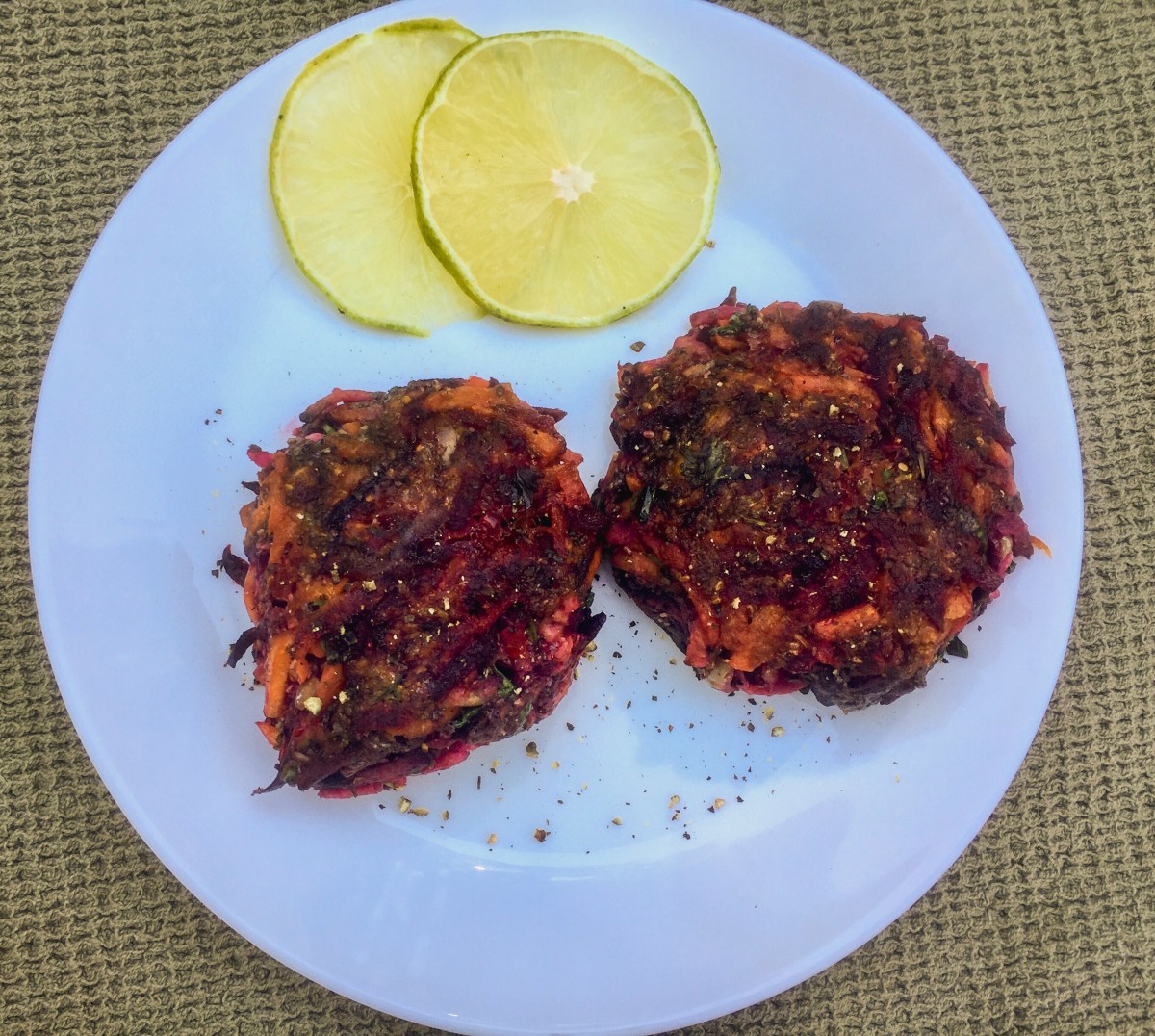
Beets, Carrots and Apple Latkes, via Eat the Vegan Rainbow

It’s early July, and here in New England (which is, for those of you who hail from across the globe, a name for the Northeastern-most part of the United States that includes six states: Rhode Island, Connecticut, Massachusetts, New Hampshire, Maine, and Vermont) the farm activities are in full swing. The greater Boston area is brimming with farms of different size and produce selection. For example, we went cherry picking on July 4th, and ended up with an amazing selection of cherries. We ate a lot, shared some with neighbors, and washed, pitted  and froze the rest. In this way, the frozen cherries are ready for smoothies, sauces or pies later in the year.

What’s in this week’s CSA basket?

At our local farm where we get our CSA (Community Supported Agriculture) share  the Upswing Farm, the vegetables this week included beets, like it did last week (and I shared  about how to pan roast beets and sauté the beet greens few days ago), carrots, zucchini, squash, cucumbers, yellow and green, cilantro, fennel, and so on and so forth. It was a really great week!

Beets are versatile!

If you are skeptical about beets, don’t be – they are versatile! Yes, you may think that I am saying that because I an Eastern European and there is a bit of a beet culture on the Balkans, but beets really can work in many different ways. In addition to the two recipes I shared last week, beets can be made into a hummus (yummy), used as a salad, sandwich or a veggie burger topping, and also made into tasty burgers (see here, and here for some great beet burger recipes to try). And they are an essential, as in not-to-be-skipped-under-any-circumstance, ingredient for fabulous BBQ ribs, either those made with wheat gluten or gluten-free.

So, how about beet fritters?

And this brings us to these fritters. Without a doubt, vegetable, and in some cases fruit, fritters are ubiquitous. Every cuisine has a recipe or two that fall into this category and take advantage of ingredients in season, often times potatoes, zucchini, squash, carrots, a grater, a bit of flour and usually some eggs, to make a quick meal. So, how about beet fritters? And how about vegan and gluten-free? Well, the recipe here answers these question in affirmative.

Chia seeds and flaxseed meal as binding agents

Grated beets, carrots and the apple make the body of these fritters. The easiest way to grate them is using a large grating attachment on your food processors, although, of course, grating by hand will work too! You don’t need to cooked the beets first, but do peel and wash them, as well as the carrots – apple is the only ingredient that does not require peeling. Just before you start grating you should start soaking your flaxseed meal by combining flaxseed meal with hot water in 1 to 3 ratio. Because the grated fruits and veggies have high moisture content, they do need extra binding agents and that’s why I recommend using quite a bit of flaxseed meal as well as chia seeds. Together, flaxseed meal and chia seeds work together to created fritters that hold their shape well without any eggs or flour.

Don’t forget the spices

I recommend using lime juice and zest, as well as freshly grated ginger and finely chopped fresh cilantro to enhance the flavors. The result are light fritters with interesting texture and


Beet, Carrot and Apple Fritters

What you’ll need:

1/4 cup golden flaxseed meal (you can use other types of flaxseed meal as well)

3/4 cup hot water

2 cups shredded carrots (4-6 carrots depending on size)

2 cups shredded beets (3-4 beets or so)

1 shredded Granny Smith apple

1 teaspoon baking soda

1 teaspoon onion powder

1 teaspoon garlic powder

1/2 lime, zest an juice

1/2 inch ginger root, grated

1/2 cup chia seeds

1/4 cup chopped fresh cilantro

Oil or cooking spray for the pan

Extra lime slices, coarsely ground black pepper and/or apple sauce for serving

What you’ll do:

  1. Place the flaxseed meal and hot water into a bowl and mix well. Let the “flax egg” rest for at least 10 minutes. The final result will be a very gooey mix that will work together with chia seeds to bind the fritters together.
  2. While the “flax egg” is resting, grate beets, carrots and an apple by hand or using a food processor equipped with a grating attachment, then transfer into a large mixing bowl. Add all the rest of ingredients, including the “flax egg”, mix well and let stand for 20-30 minutes. This resting time is needed for chia seeds to soak the extra liquid released by the grated beets, carrots and apple, and transform into a gel-like substance.
  3. Place a large pan over high heat and let it get nice and hot. Add oil or some cooking spray – if you do have a great non-stick pan you can omit the oil – and place small firm patties in. To form a patty, take about 1/4 cup worth of your mix, and using your hands form a 1/2 inch thick patty. Brown over high heat for 2 minutes then lower the heat down to medium and continue browning for 3 more minutes.
  4. Flip the patties over and brown on the other side for 3-4 minutes.
  5. Serve warm as a side dish, or even as an alternative to breakfast pancakes. These fritters go well with yogurt, as well as maple sauce, and I bet they would be delicious cold as well!
BeetCarrotApple_Fritters
Beet, Carrot and Apple Fritters, via Eat the Vegan Rainbow on Pinterest

Copyright © Eat the Vegan Rainbow, 2018

CSA Week 3, Part 2: Balsamic Vinegar Glazed Beets and Turnips

img_5245
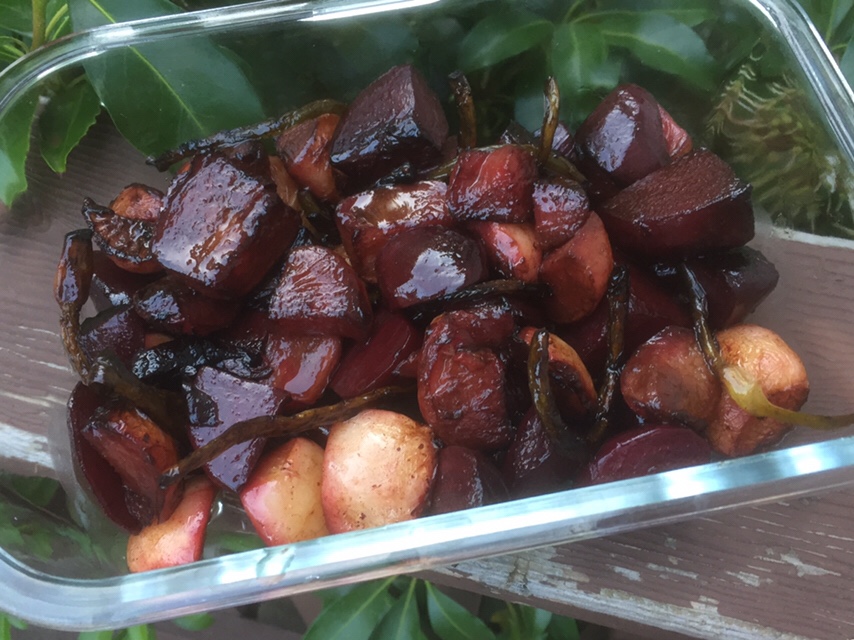
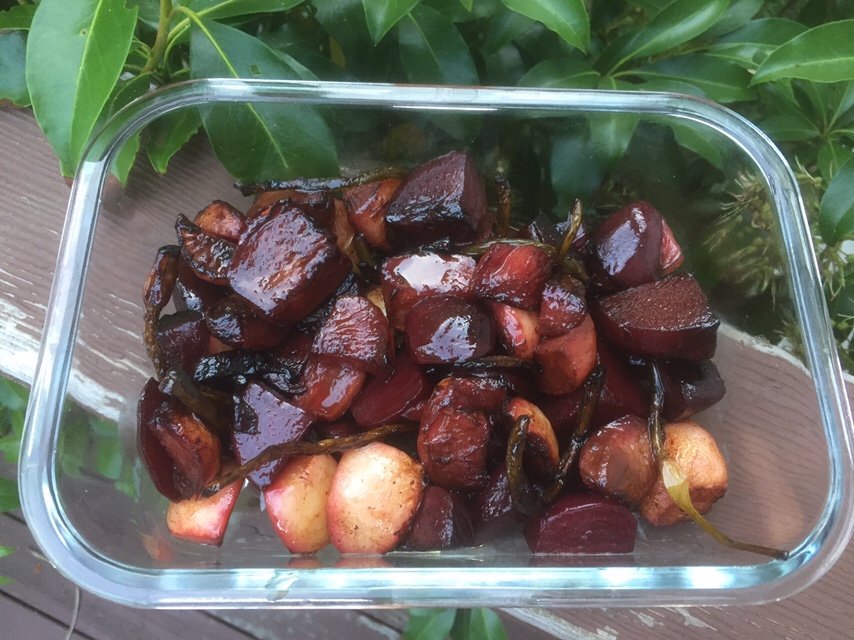
Balsamic Vinegar Glazed Beets and Turnips, via Eat the Vegan Rainbow

Community Supported Agriculture (CSA) is a lovely way to support your local farmers, enjoy the freshest produce and diversify what’s on your plate. This summer I signed up for a share at Upswing Farm, our local, small scale farm that’s relatively new – it opened it’s doors just 2 years ago. So far, the shares were great, with excellent quality of local produce as well as a couple of items that I’ve never seen in my life before.

Introducing garlic scapes

CSA-Garlic-Scapes
By Evan-Amos [Public domain], from Wikimedia Commons
In week 3, one such item were garlic scapes, which are twisty and curly green stalks that grow out of garlic plant and if left alone would develop a flower at the top. However, they are removed, usually in late spring and early summer, in order to help the growing garlic channel its energy into the bulb not the flower. The scapes are edible – who knew! – and full of the same garlic flavor so you can use them instead or in addition to (if you really love your garlic) the garlic cloves. I usually chop them finely, but they are funny looking and for this pan roast I decided to leave them intact, after trimming off the ends. If you don’t have garlic scapes, you could use garlic cloves, or whole scallions (green onions), or green (young) garlic. Any one of these will work to infuse your beets and young turnips with some nice flavors.

Pan roasting beets and turnips

The stars of our Week 3 CSA share were a bunch of beets and a bunch of baby turnips. Unlike huge and heavy turnips you usually find in the grocery store, these turnips are smaller and softer. You can cook them without peeling, and they require much less prep time then their more mature versions. They are delicious roasted, as are the beets.

But, we are in the middle of a heat wave and turning the oven on seems extremely unappealing. So, Dutch oven to the rescue! If you don’t know what a Dutch oven is, it’s a very heavy cast iron pot that is perfect for achieving nice caramelization without actual roasting. The best way to do this is to be patient, keep the heat on medium, put the lid on, and stir infrequently. This will help cook the veggies through while at the same time giving them nice roasted look and feel.

Don’t forget the glaze

What also helps the stove top roasting process is a simple balsamic vinegar glaze. This is nothing more than a splash of good quality balsamic vinegar that gets cooked and concentrated with the beets and turnip. The result is a shiny and rich side dish that works well warm as well as cold, especially as a topping for salads.

Don’t throw away the leaves

And since these are all really fresh pieces of produce, don’t forget that you can use the entire plant. So, don’t throw away the leafy parts of your beets and turnips as they can be made into a yummy side dish!


Balsamic Vinegar Glazed Beets and Turnips

What you’ll need:

1 bunch (5-6 medium) beets, washed, peeled and cubed

1 bunch young turnips, washed and cubed

5-6 garlic scapes, washed, trimmed, and roughly chopped into long pieces

2 tablespoons olive oil

1/4 cup balsamic vinegar


What you’ll do:

  1. Place a large Dutch oven or a cast iron pan over the medium high heat. Add the oil and garlic scapes. Brown for 1-2 minutes than add the cubed beets and turnips.
  2. Let the vegetables brown on one side before turning them over. This will take 5 minutes or so per side.
  3. After they’ve browned on two sides, add the vinegar and deglaze the bottom of the pan.
  4. Lower the heat to medium low, put the lid on and “roast” the vegetables for 20-25 minutes. Stir occasionally. Both beets and turnips should be soft when you pierce them with a fork, but not mushy or falling apart.
  5. Serve warm, or enjoy cold. The “roasted” beets and turnips will keep for close to a week in the fridge.

Copyright © Eat the Vegan Rainbow, 2018
CSA Week 3, Part 1: Beet and Turnip Greens

img_5195
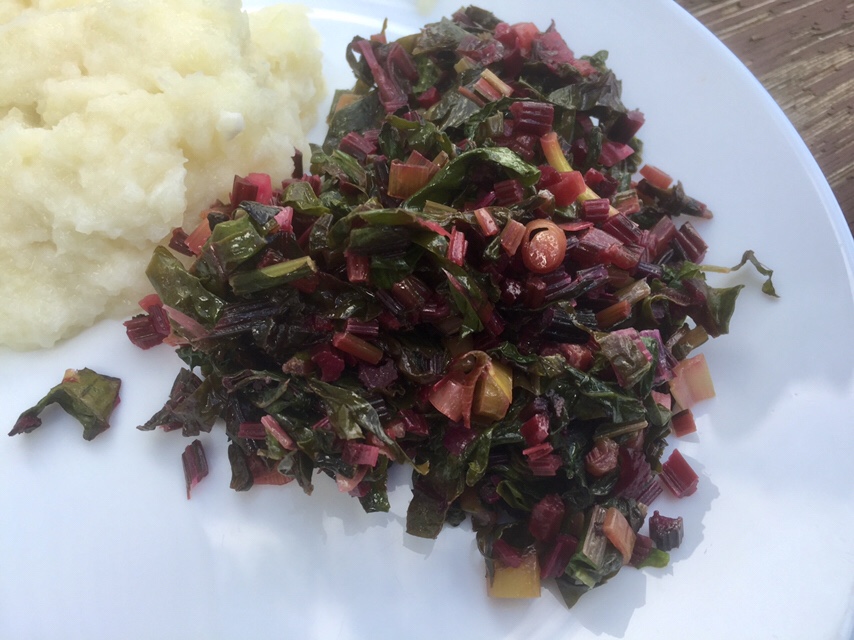
Sautéd Beet and Turnip Greens, via Eat the Vegan Rainbow

This summer I am doing something new – getting some of my produce from a local farm via the CSA, which stands for Community Supported Agriculture. I signed up for a large share at Upswing Farm, where the farmers Brittany and Kevin Overshiner are trying to protect the land they are using from the pressure to develop it into housing, as well as growing some yummy vegetables and beautiful flowers all while respecting the nature and the environment.

Beets and turnips in our CSA share

We are already in Week 3 of our CSA share, and this week the loot included a bunch of beets and a bunch of baby (young) turnips. Although I usually get both beets and turnips when they are much more mature and without any leaves to speak of, knowing how fresh this produce is made me think that I should really be using the entire plant. So, I looked around for recipes and decided that a simple saute would work well. And it did – the greens spoke for themselves with just a bit of help from young garlic* and olive oil!

The result is a wonderfully colorful side dish that goes with anything really. You can serve it with your veggie burgers, rice, pasta, mashed potatoes, or make it into a sandwich. I personally like to combine this sauté with some meatless meatballs and almond yogurt. Yummy!

And if you are wondering what to do with the rest of your beets and turnips, why not try pan roasting them on the stove top?

* Note: if you do have green garlic on hand, use both the white and the green bits, and if you don’t have access to green garlic, just use the regular kind. You can crush it, but I prefer slicing the cloves very thinly – it adds not only flavor but a bit of an interesting bite to the dish.

Sautéd Beet and Turnip Greens

What you’ll need:

3-4 cups beets greens, washed and chopped (leaves and stems from one bunch of beets)

3-4 cups turnip greens, washed and chopped (leaves and stems from one bunch of young turnips)

4 cloves garlic or 4 young (green) garlics, finely chopped

2 tablespoons olive oil


What you’ll need:

  1. Place a large sauté pan over medium heat. Add the sliced garlic and sauté for 1-2 minutes with stirring. Garlic can burn quickly, so do keep an eye on it!
  2. When garlic is slightly browned, add the chopped greens. The volume is going to be huge at the beginning but be patient and let the greens wilt slowly and gradually. I like to use a pair of tongs and keep turning the greens over every few minutes.
  3. Once the leaves are fully wilted, lower the heat and sauté for 15-20 minutes. This will help the bits of stems soften and cook through.
  4. Serve with mashed turnips, or pan roasted beets and turnips for a lovely and healthy meal!

Copyright © Eat the Vegan Rainbow, 2018
Warm Kale and Chickpea Salad

img_4717
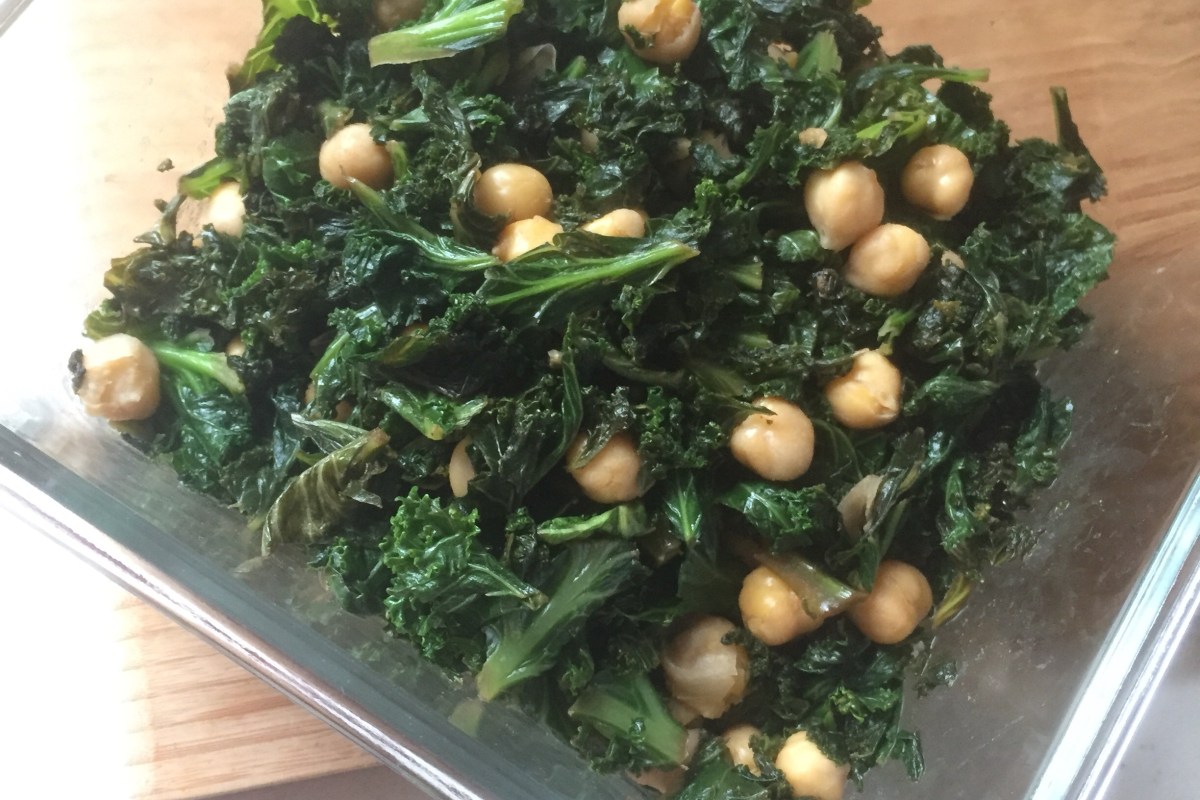
Warm Kale and Chickpea Salad, via Eat the Vegan Rainbow

Everybody is raving about kale. It’s a must-have super food and I’ve seen so many requests from people asking for suggestions and ideas on what to do with it. An obvious choice for kale is a soup, where the earthiness of kale and it’s sturdy structure add an interesting bite to it. Many also recommend using kale in smoothies, which I am not really all that interested in doing.

Another obvious choice is to use kale in salads. Unfortunately, kale is really sturdy and the only option you have for using it in salads is to go with baby kale. I used baby kale in the past, like in this salad full of great flavors of roasted beets, leeks, baby kale, and lemon vinaigrette.

But, recently I started playing around with ways to make kale work in a salad form, and discovered that the best way to do it is to sauté the kale to soften it. Also important is to remove all the big stems first – they are tough and chewy, so best removed before cooking. This makes the prepping process a bit tedious – you need to take a bunch of kale, wash it, remove the stems, and chop it – and very often I don’t really feel like doing it. You can buy chopped kale these days; however, most brands don’t do a great job at removing the pesky stems, so you will still need to inspect the kale carefully and ensure that all stem bits are out.

So, is this salad worth the fuss? Perhaps the best way to determine is to try it once and see what you think. I recommend serving it warm, just a bit above the body temperature, but cold works too!

img_4719

Warm Kale and Chickpea Salad

What you’ll need:

1 lbs (454 g – call it 500 g) stemmed and chopped kale

4 cloves of garlic, thinly sliced

2 tablespoons balsamic vinegar

1 cup cooked chickpeas (from the can or homemade)

1 tablespoon olive oil

Salt and freshly ground black pepper to taste


What you’ll do:

  1. De-stem kale with care, and chop roughly.
  2. Place a large frying or sauté pan over a medium heat and add the olive oil.
  3. Next, add the sliced garlic and let it sauté for just a minute.
  4. Add the kale and mix well to incorporate all the garlic. Let the kale sauté for 8-10 minutes. The kale should be fully cooked!
  5. Add balsamic vinegar, mix well and keep the heat on for 1-2 more minutes.
  6. Turn the heat off, add the chickpeas, and salt and pepper (if using) and mix well.
  7. Transfer the salad into a serving dish, and let it stand until just warm. The leftovers will store well in the fridge for 2-3 days, and you can enjoy this salad without reheating. Makes a great stuffing for a pita bread sandwich!

Copyright © Eat the Vegan Rainbow, 2018


Asian Meatballs with Spiralized Zucchini and Carrot Salad

Vegan, fully plant-based meatballs are one of the easiest thing in the world to make. I like putting meat-free “meatballs” together because they are fun – fun always comes first of course – and they are versatile, you can stick them into a sandwich, over pasta, serve with mashed potatoes, with rice and beans, and the list goes on and on…

Plus: unlike dealing with meat, especially poultry, all the ingredients in these meatballs are safe to eat as is, which means that even young kids can get involved and roll some meatballs. I told you – these can be fun for everyone!

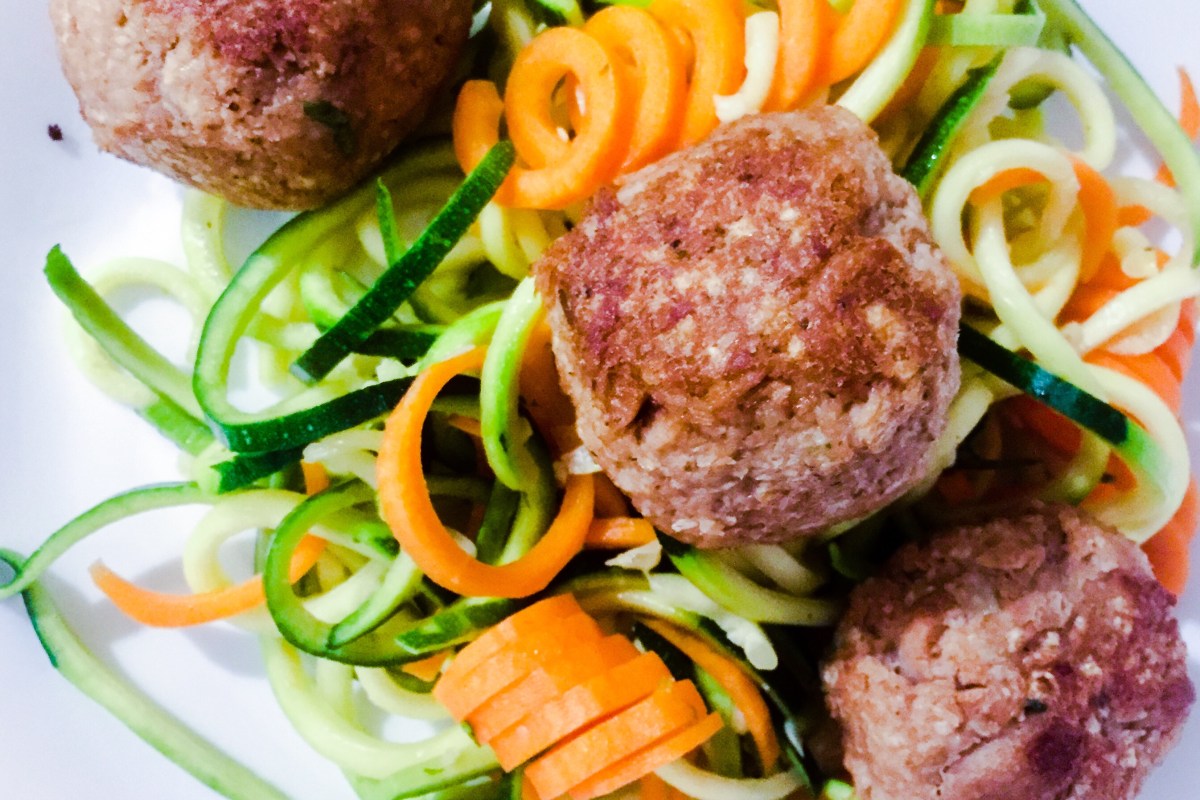
What makes these meatballs Asian is the combination of scallions (green onions), Sriracha (hot red chili sauce), fresh ginger, panko (Japanese breadcrumbs), and peanut butter that get mixed with chopped, not ground, soya chunks. The idea is to retain some of the soya chunks structure rather than grind them to the consistency of ground beef. Think chicken salad, rather than taco meat.

To complete the meal you will need to do some spiralizing, which is one of my favorite things to do with zucchini, summer squash, and even potatoes. Here, I combined carrots and zucchini which gives the salad a nice contrast of crunch versus softness, plus a colorful appearance. The spiralized vegetables are mixed with some slivered almonds, lime juice and zest, and tossed to combine. Top them with a meatball or three, and you got yourself a dinner!

Asian Meatballs with Spiralized Zucchini and Carrot Salad

What you’ll need:

FOR THE SALAD

3 zucchinis, spiralized

3 fat carrots, spiralized

1/2 cup slivered almonds

1 lime, juice and zest

FOR THE MEATBALLS

200 g soya chunks

1 1/2 cup panko, Japanese breadcrumbs, regular or gluten-free

3 scallions, white and green parts, finely chopped

1 tablespoon ginger, freshly grated

1 tablespoon peanut butter, natural and unsalted

3 tablespoons soy sauce, reduced sodium

1/2 teaspoon hot chili sauce (sriracha)

Cooking spray


What you’ll do:

  1. Prepare soya chunks according to the instructions on the box. They usually need about 3-5 minutes in a pot of boiling water.
  2. Drain and rinse your soya chunks under some cold water, then chop or grind them into small chunks, similar to chicken chunks commonly used in Asian Dumplings recipes. Place them in a large bowl, and add all the rest of the ingredients. Mix everything well and let stand for 5-10 minutes before making the meatballs.
  3. Heat a large skillet or a cast iron pan over the medium high heat. Spray with some cooking spray and brown the meatballs on all sides until golden brown. Brown the meatballs in batches and make sure you don’t overcrowd the pan.
  4. While the meatballs are browning, prepare the salad. You can either buy a box of spiralized carrots and spiralized zucchini and toss them with some lime juice, lime zest, and toasted slivered almonds, or you can spiralize your own if you have the spiralizer. Let the salad rest while the meatballs finish browning.
  5. To plate, place a good amount of salad in the middle of the plate, and top with 2-3 meatballs. Enjoy!

Copyright © Eat the Vegan Rainbow, 2018

Saffron Cauliflower Rice

img_3510
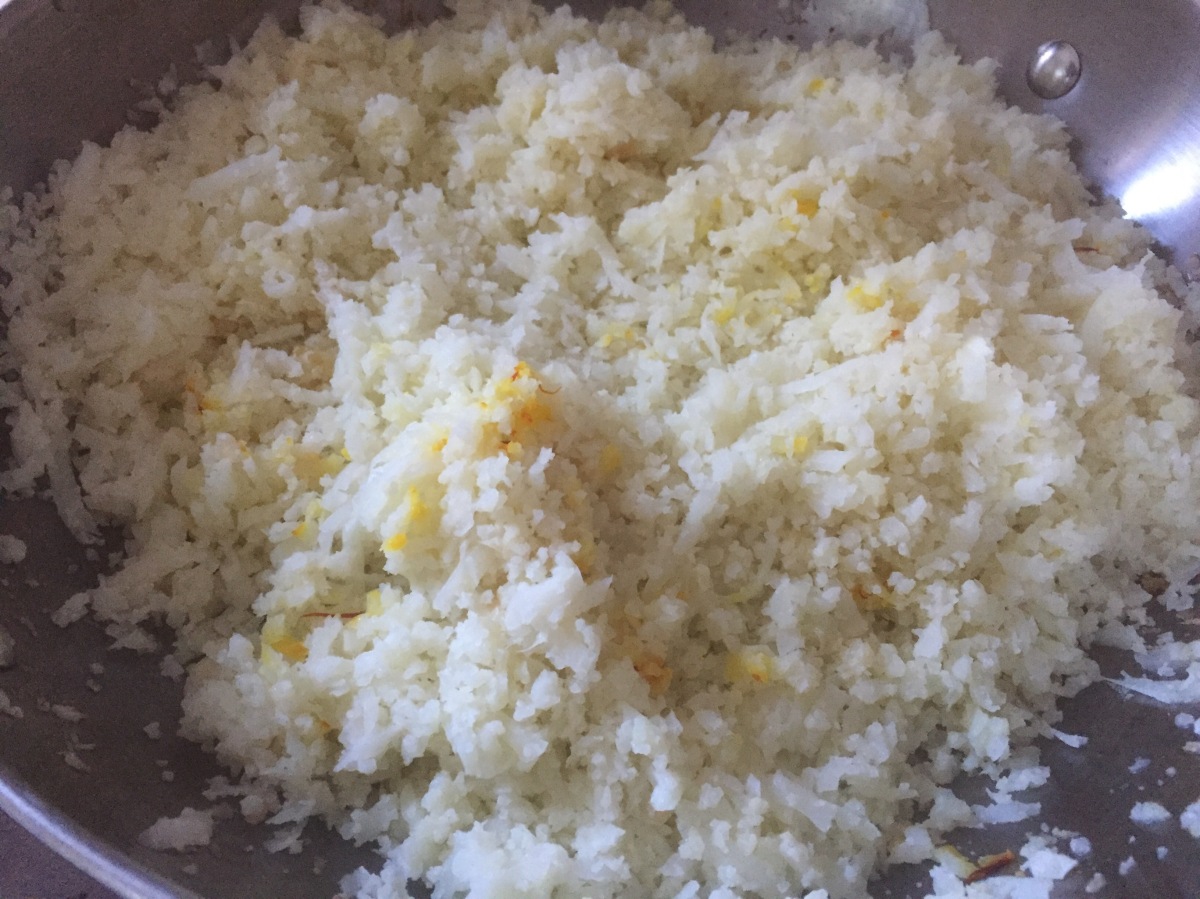
Saffron Cauliflower Rice, via Eat the Vegan Rainbow

Is there a more gorgeous looking vegetable than cauliflower? This is, of course, a rhetorical question because the answer to anyone who has ever held a perfect head of cauliflower in their hands should be an obvious “No!”.

Cauliflower florets are a perfect ingredient for things like vegan Buffalo wings – if you haven’t tried those yet drop whatever you are planning to make, and prepare the Buffalo wing right now! Cauliflower is also great for soups, pickled, and in curries.

In addition to all that, cauliflower can also be made into rice. Yes, you read that right – cauliflower = rice. It may strike you as strange but do follow along and you’ll thank me later. The cauliflower rice is something that was invented to fit the whole paleo eating craze – an alternative to rice that’s carb-friendly. I had it as a sort of cauliflower “risotto” and that was OK. I’ll make it again one day, and share here once I work out the ways to improve it.

The recipe here, on the other hand, is great as is, which may be hard to believe given that it’s just cauliflower with some saffron in it. The inspiration for Saffron Cauliflower Rice was my recipe for basmati rice, one of the favorite side dishes I serve with most of my Indian-inspired dishes, like Chicken-less Tikka Masala, Jackfruit Tikka Masala, Creamy Mango & Chickpea Curry Tofu, or Tofu Saag.

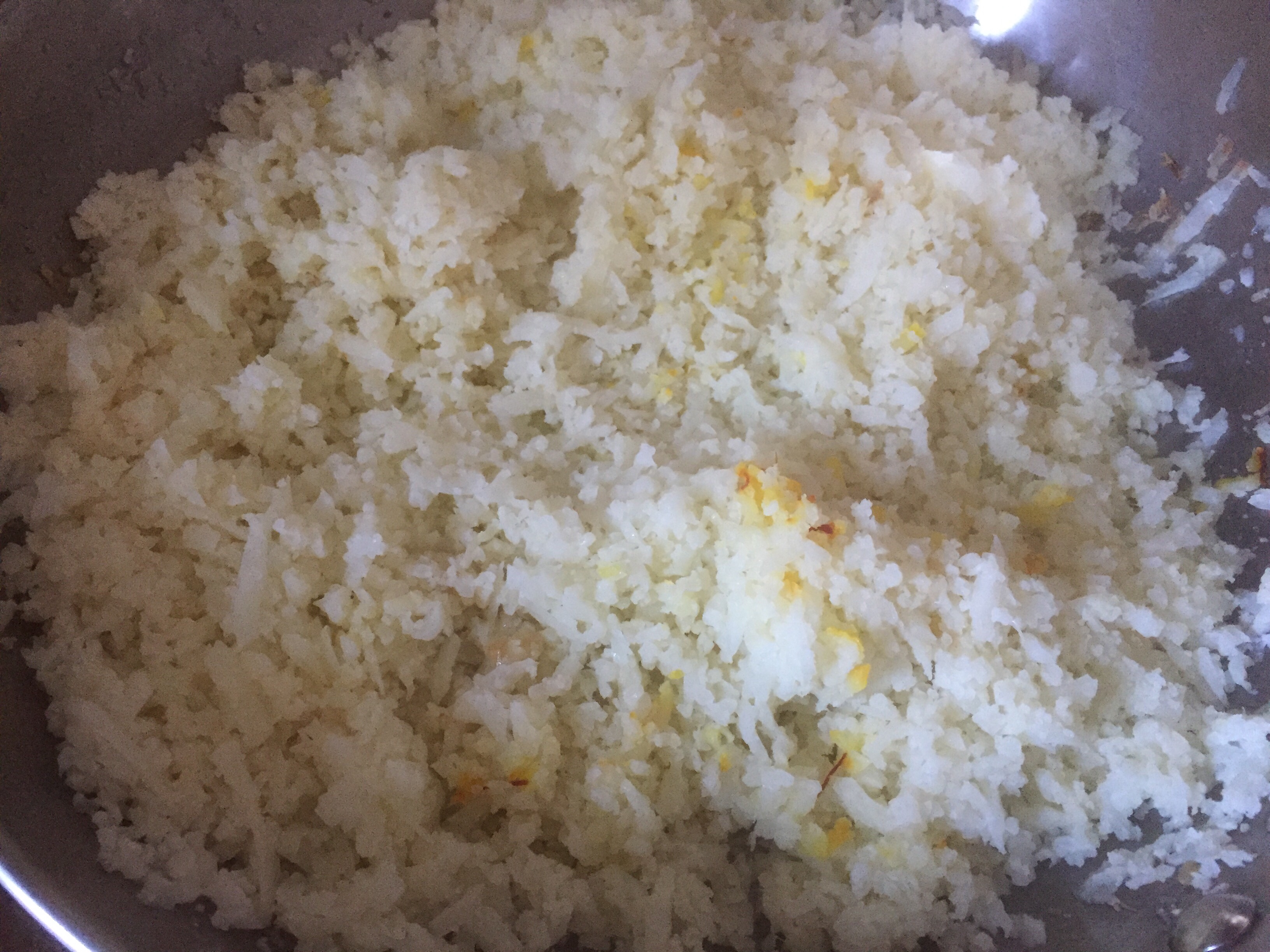
I was looking for something to serve with my meatless Koftas, and since I had a lovely head of cauliflower on my hands I went for it. All you need to do to make the rice is to run your cauliflower through a food processor. I used relatively closely chopped florets but you can use as much of the stems as you like. Depending on the size of your food processor you may need to do the zapping in batches. The ricing itself takes only a couple of 2-5 second pulses. At the end your cauliflower should be the size of rice grains. For basmati rice texture, the grains should be a bit larger than for risotto. But, the size of cauliflower rice “grains” will have no impact on cooking, it’s for esthetic quality only, so use your judgment to decide whether you need to be that nit picky.

Making of cauliflower rice takes less time and is more hands off then making rice, so all in all once you are done grating, using a food processor or a grater, the cauliflower rice will be ready in about ten minutes. You can serve this saffron as a side with any Indian, North African or Middle Eastern recipe, like the lovely koftas I already mentioned!

Saffron Cauliflower Rice

What you’ll need:

1 large head of cauliflower

1/4 cup water (if needed)

3-5 springs of saffron

Cooking spray or olive oil


What you’ll do:

  1. Wash the cauliflower, cut the florets and place them into a food processor. Process the cauliflower into rice grain size pieces.
  2. Spray the bottom of a large pan with cooking spray, or use a tablespoon of oil. Place over the medium heat and add the cauliflower rice. Let the cauliflower sauté for 10 minutes, stirring occasionally.
  3. Add the water to help scrape any cauliflower rice that’s stuck to the bottom off, stir well, than place saffron on top, put the lid on the pan, lower the heat and let the cauliflower rice simmer for another 5 minutes. The saffron will release its magic yellow-orange color and the cauliflower rice will be done. Don’t stir it too much – I like the non-uniform color and it makes for a striking plate presentation!

Copyright © Eat the Vegan Rainbow, 2018

Baked Summer Squash Noodles with Pumpkin Seed Pesto

img_3654
Summer Squash Noodles with Pumpkin Seed Pesto, via Eat the Vegan Rainbow

A sunny day in late November is a real treat. It sends strong reminders of the summer that’s gone, and that, as well as too much root vegetables on the plate over the Thanksgiving holiday, made me reach out for summer squash.

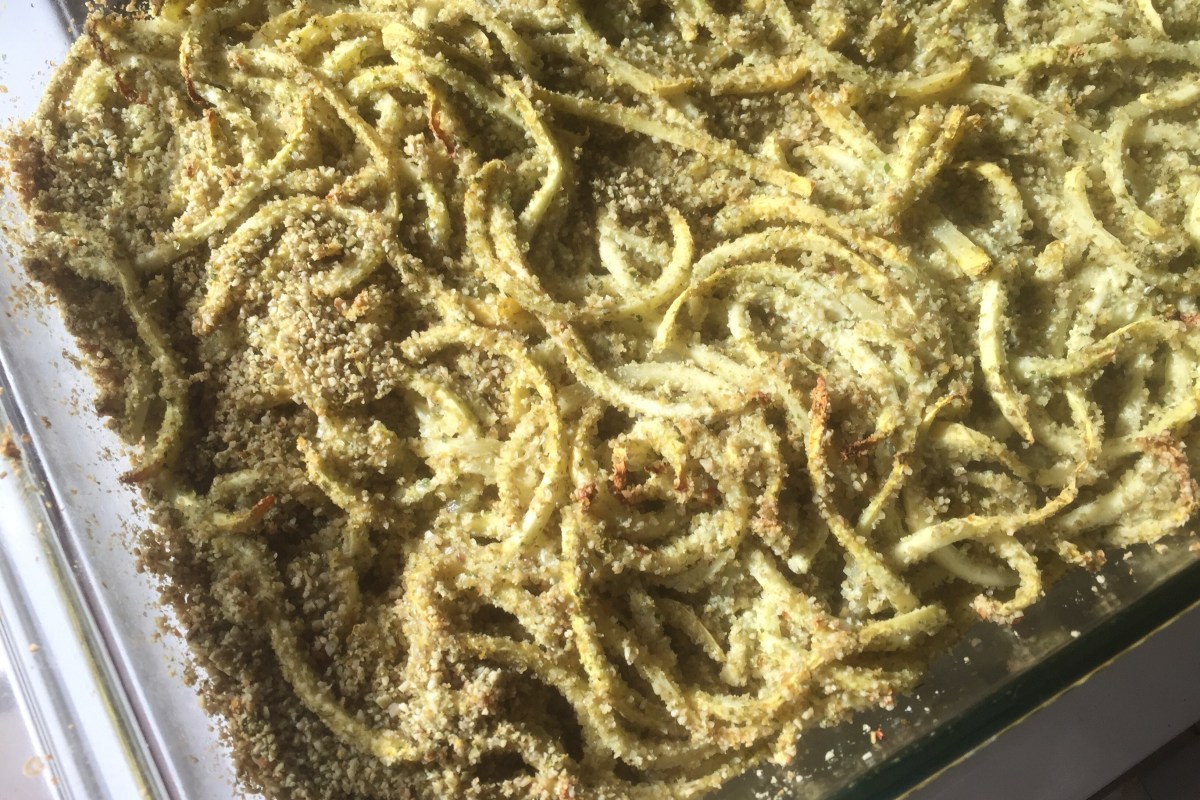
Summer squash is not something I routinely make. I prefer zucchini and Italian squash, but this time around it was the summer squash that looked the freshest so that’s what I got. I used my spiralizer to make some summer squash noodles – if you don’t know what spiralizer is, it’s a kitchen gadget that you’d think you can totally live without but in reality you really can’t.

Joking aside, spiralizer is a gadget that makes long, amazing noodles from all sorts of vegetables and fruit. Initially, I thought I can get by with a mandoline slicer – and that worked fine couple of times. But, after buying spiral cut zucchini from the store few times – and paying through the roof for it – I finally broke down and bought an actual spiralizer. The gadget paid off for itself already, and I’ve enjoyed spiralizing zucchini, summer squash, sweet potatoes, apples and beets.

I paired summer squash with a simple oil-free pumpkin seed pesto, which has four ingredients only: raw pumpkin seeds, roasted garlic, fresh parsley and nutritional yeast. The pesto comes together in a food processor in less than two minutes and it’s ready to use immediately. Plus, the pesto uses pumpkin seeds so in a way builds on all the pumpkin craziness of the season, which I kicked off with my Pumpkin Truffles.

You can make this dish completely oil free, but I did use some cooking spray to oil the baking dish. It helps brown the pesto and the squash, and it does help with cleaning up. This baked summer squash “pasta” goes well with a side of chopped roasted red peppers, some shredded vegan cheese, ripe avocado slices, or a squeeze of lemon. It’s easily customizable, but it’s also a meal on its own.

Note: this same recipe would work with spiralized zucchini or spiralized Italian squash!!!

Baked Summer Squash Noodles with Pumpkin Seed Pesto

What you’ll need:

5 pieces of summer squash, spiralized

2 cups pumpkin seeds, raw

1/2 cup flat leaf parsley

3 cloves garlic, roasted

2 tablespoon nutritional yeast

Cooking spray

What you’ll do:

  1. Preheat the oven to 350 F (175 C).
  2. Spray the bottom and sides of a large and deep baking dish with cooking spray.
  3. Place your spiralized summer squash in a large mixing bowl.
  4. In a food processor combine pumpkin seeds, roasted garlic, fresh parsley and nutritional yeast. Pulse until a fine pesto forms.
  5. Pour the pumpkin seed pesto over the summer squash noodles and toss to combine.
  6. Pour everything into the baking dish and bake uncovered for 15-20 minutes.
  7. Cover the baking dish with foil and bake covered for another 15 minutes or so. Serve hot, or cold as a salad with a drizzle of balsamic vinegar!!!

Copyright © Eat the Vegan Rainbow, 2018

Unbelievably Easy Baked Polenta Sticks

img_3352
Baked Polenta Sticks, via Eat the Vegan Rainbow

I was raised eating polenta with milk and sugar for breakfast. As I grew up and started experimenting with my food, I would add sour cream and even ajvar, the roasted red pepper and eggplant spread many associated with Bulgaria and the South East Balkans. But even with these add-ons, polenta remained a breakfast food.

So, I was quite surprised to discover that fancy Italian restaurants include polenta on their dinner menus. Of course I had to try it, and I liked it! I actually never met a polenta I did not like. And as a cook it’s something that you can whip together in minutes!

Polenta is basically boiled coarse corn meal, so it is in the same food family as grits. And, practically speaking it is as easy as it sounds – you bring a pot of water to boil and you add some corn meal to it while stirring constantly and furiously to prevent clumping. You let the pot boil for five minutes with constant stirring and the polenta is done.

The recipe here is two steps removed from the basic polenta. First, after you make the polenta according to the instructions on the box, you will need to pour it into a deep baking dish which is either lined with some parchment paper or well sprayed with the cooking spray. Spread the polenta into one even and smooth layer and let it set for at least an hour.

Once the polenta has set and hardened you will be able to slide it out of the dish and onto the cutting board. Slice polenta into 1 x 2 in (2.5 x 5 cm) sticks and arrange them on a baking sheet. Spray the tops with a cooking spray.

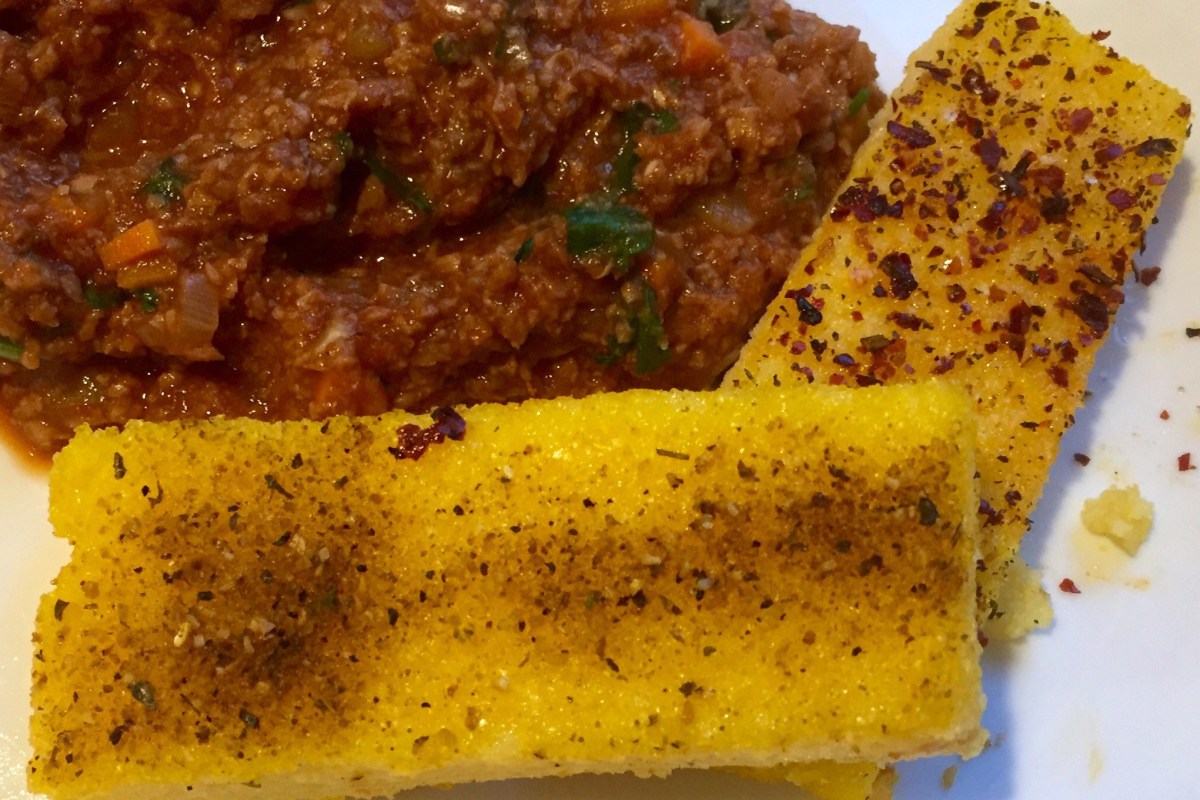
From here you can take your polenta in any direction you like. You can add fresh or dry spices, nutritional yeast, small bits of cheese or vegan butter that melt well, or sprinkle sugar and cinnamon if you want to make the baked polenta sticks into a dessert. Here, I decided to go two ways and top one set of polenta sticks with some cumin powder, dry basil and oregano. The second batch I spiced up a bit with freshly ground black pepper as well as smokey red pepper flakes. The topped polenta stick are then baked until their surface is nicely browned.

I served the Baked Polenta Sticks with vegan bolognese sauce but you can eat them as is, or serve them with a wide range of dishes. The flavor of polenta sticks is mild, slightly nutty, and depends on the spice combination you used. In general, Baked Polenta Sticks are great with any dish you would serve with corn bread, like chili, Jackfruit Barbacoa, or Bean and Leek Soup. They can also be used as an appetizer, served along side simple marinara dipping sauce and some olives.


Baked Polenta Sticks

What you’ll need:

2 cups polenta (or corn meal)

4 cups water

1/4 teaspoon salt (adjust salt to taste)

Cooking spray

Dried basil

Dried oregano

Cumin powder

Crushed red pepper flakes

(Onion powder, garlic powder, nutritional yeast, freshly ground black pepper, lemon zest,… quite a few toppings will work so feel free to experiment)


What you’ll do:

  1. In a large pot, bring water to boil.
  2. Add the salt and polenta to the boiling water while stirring rapidly to prevent clumps from forming. Decrease the heat to medium/medium low, and keep stirring the polenta for about 5 minutes.
  3. Pour the polenta out into a baking dish that you previously sprayed with cooking spray. I recommend using 9 x 13 in (22 x 33 cm) dish for this amount of polenta – this will give you 1/2 in (1 cm or so) thick sticks – but you can use any other flat bottom container you have on hand. Just note that the thickness of the sticks will vary depending on what you use.
  4. Let the polenta cool and set for at least an hour. The thicker your polenta layer, the longer it will take.
  5. Slide the polenta slab out onto a cutting board. Cut into sticks of regular size.
  6. Arrange your polenta sticks on a parchment paper lined baking sheet. Do leave some space between the stick so they can bake evenly, which means you may need to use two baking sheets or bake in two batches.
  7. Spray the top with some cooking spray and sprinkle the toppings/spices of your choice liberally.
  8. Place into the oven that was preheated to 400 F (205 C). Bake for 15 minutes or until the sticks are golden brown.
  9. Serve as a side dish with a soup, or as an appetizer with marinara sauce, or simply munch on these any time. They are best served fresh from the proven, but couple of minutes in a toaster oven will help the next day!

Copyright © Eat the Vegan Rainbow, 2018

Bubble and Squeak – Just in Time for the Holiday Leftovers

img_3704
Bubble and Squeak, via Eat the Vegan Rainbow

Don’t worry if you have never heard about Bubble and Squeak – that just means you are not English, you don’t have any friends or family members that are English, and you have never lived in England, all of which is OK. But, if you know what Bubble and Squeak is, you are probably already smiling to yourself and licking your lips in anticipation.

My own links to England are mostly literary, as I adore Agatha Christie and Terry Prachett, and have a special place in my life for J.R.R. Tolkien, Jane Austen, A.A. Milne and Lewis Caroll, although I’ve also ingested a huge amount of TV shows, devouring every episode of Midsomer Murders, Inspector Morse,  Inspector Lewis, Poirot, Miss Marple (with all different lead actresses), and Sherlock Holmes (with Jeremy Brett!) ever made. I also have a few English friends, who enjoy sharing their recipes with me, and that’s how Bubble and Squeak came up. With an adorable name like that I had to go for it.

Now, if I was naming this dish I would call it Leftover Mash, because that’s what it is. It is used in England to revive any leftover from a roast dinner or another large, formal meal that includes potatoes, meat and veggies. The leftovers are chopped up and fried together and apparently if you are using cabbage you will hear bubbling and squeaking.

For me, it was not a large amount of leftover that made me do it, it was my attempt to give way to give Brussels sprouts another chance. I grew up eating huge amounts of cabbage – it’s one of those cultural things mixed with practical where cabbage, and especially fermented cabbage (sauerkraut) can carry you through a rough and long winter at a time when fruits and veggies were a seasonal thing (those days are gone now, by the way, with  year round availability of almost everything!). And I love cabbage, and many of it’s cousins, like cauliflower (which I used here, here), broccoli, kale (like in this soup), radishes, and many, many more. the cruciferous vegetables, as they are collectively known, are numerous and diverse, and include many things I like to eat… and there is the Brussels sprouts.

I tried Brussels sprouts several times before, mostly roasted and once boiled (never again on that one!), and was left unimpressed. But, when Bubble and Squeak was mentioned it sounded like I should give the Brussels another chance. And it worked! At the end, I am not at all sure that what I made qualifies as a traditional Bubble and Squeak, however it is a good dish for anyone looking to jazz up their potatoes, or use leftover cabbage or Brussels sprouts. I think it would probably work with leftover collard greens and spinach as well, and will probably work with leftover sweet potatoes or mashed squash.

Having said all that I did have to add one secret ingredient to make this work. My secret is bacon, or to be more precise Rice Paper Bacon. The recipe for this bacon is very similar to the one for Tofu Bacon, which I loved, so I jumped on the opportunity to give this new thing a try. The rice paper bacon worked well, it delivered on the bacon aroma, and it was very crispy, so perfect for sandwiches or similar. It also worked well with the Bubble and Squeak to add the aroma and a boost the flavor. At the end, I think tofu bacon would have worked better for this dish, but rice bacon gets big thumbs up for being a very good meat-free, homemade bacon alternative.

So with some boiled potatoes, boiled Brussels sprouts, diced onions, and rice paper bacon in hand, you will be ready for the Bubble and Squeak. All you need to do is fry it all together, or if you are a bit more health conscious sauté with only a tiny bit of oil to help everything come together. Although I have not done so myself this time around – I was in a bit of a time pinch – you can finish the dish in the oven. In retrospect, letting Bubble and Squeak sit under a broiler for less than five minutes would have given it a nice look and an interesting crunch. For those of you who are traditionalists, you are supposed to flip the whole thing half way through and brown both sides that way. I’d say, with just a bit of broiling you can skip the flipping. The whole thing is supposed to be able to slide out of the pan, but even if it doesn’t it’s still an interesting dish!

This slideshow requires JavaScript.


Bubble and Squeak

What you’ll need:

1 yellow onion, finely diced

1 red onion, finely diced

4 potatoes, boiled and mashed, or 2 cups of leftover mashed potatoes

2 lbs (900 g) or 1 stalk Brussels sprouts, boiled and chopped, 2-3 cups leftover roasted or boiled Brussels sprouts, chopped

1 cup crumbled rice paper bacon or finely chopped tofu bacon, store-bought or home-made

2 tablespoons oil, vegetable or canola


What you’ll do:

  1. In a heavy pan – oven proof if you plan to finish the dish under a broiler – heat the oil over the medium high heat. Add the onions and let them sauté until fully caramelized. This will take about 10 minutes. Note: if you are using store-bought “bacon”, chop it finely and add it now, so that it had time to render any fat, as well as brown. If you are using rice paper bacon you will add it towards the end of the cooking process.
  2. Add the mashed potatoes. If you are using the leftovers, you don’t need to worry about making mashed potato from scratch. But if you are making this dish de novo then peel, wash, chop into cubes and boil the potatoes for 30 minutes or so, than mash until rustic – no perfect smoothness required here.
  3. Add the finely chopped Brussels sprouts. Same as with the mashed potatoes, if you are using the leftovers just chop and drop, if you are starting from raw boil the sprouts for 15 minutes or so, drain and squeeze the access water out, then chop finely and add to the pan.
  4. Mix well until everything is well-incorporated.
  5. Decrease the heat to medium and let your bottom get crunchy, if not even slightly burned. Add the bacon bits, mix in gently without disturbing your crunchy bottom (no jokes, please!), then flip the Bubble and Squeak so that the top can brown, or stick the whole thing under a broiler without flipping. You can also skip the flipping/broiling and enjoy as is!

Copyright © Eat the Vegan Rainbow, 2017

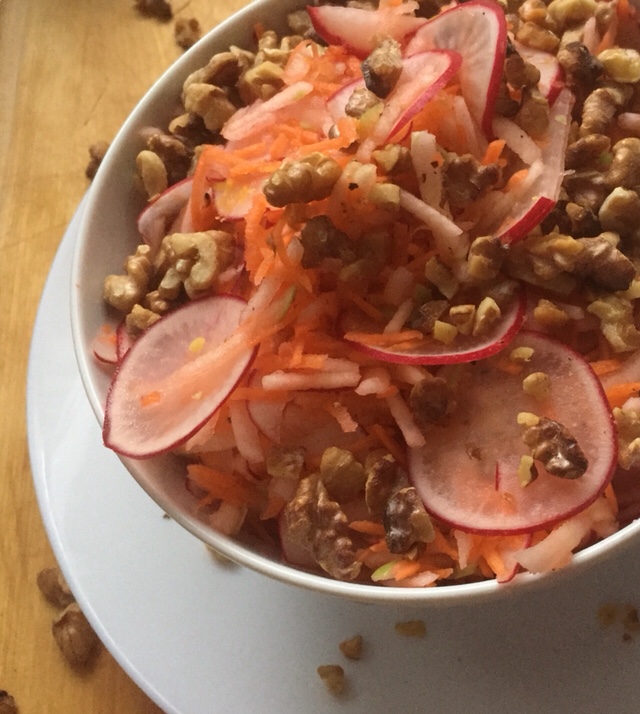
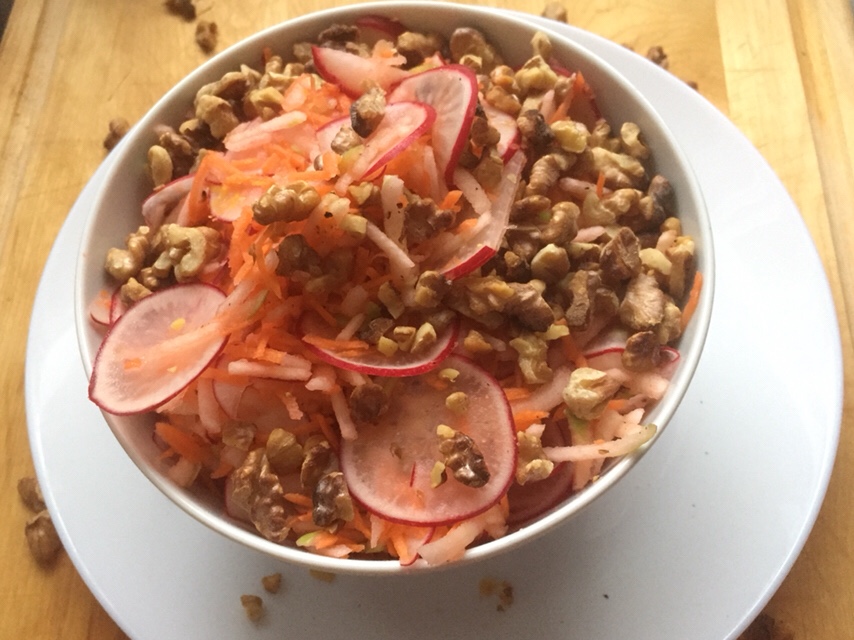
Radish Salad with Apples, Carrots and Toasted Walnuts

img_3783
Radish salad with Carrots, Apples and Toasted Walnuts, via Eat the Vegan Rainbow

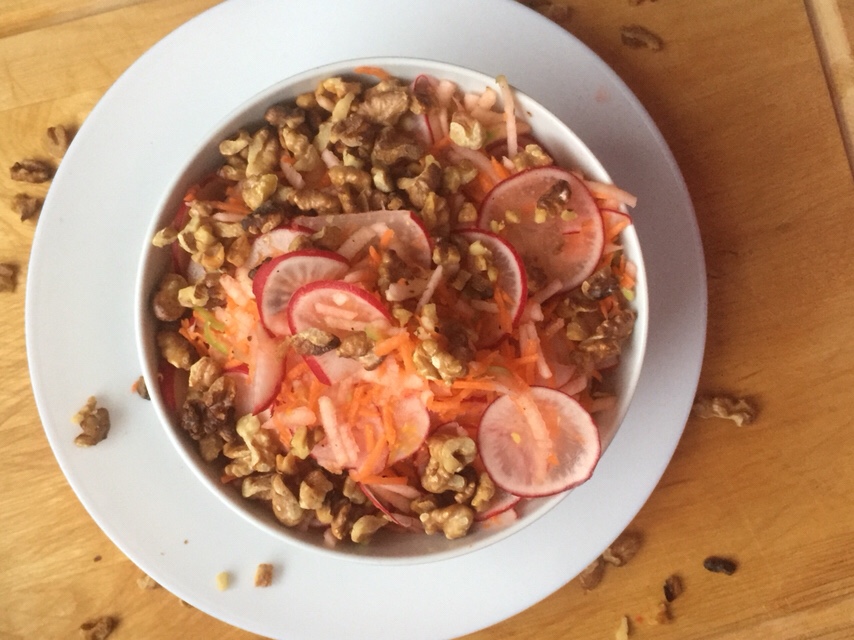
Who said salads have to be green? Or soaked in heavy dressing? Salads come in many different shapes and forms, and this is my contribution to the pantheons of salads – a mix of sliced radishes, shredded carrots and apples, toasted walnuts and freshly squeezed lemon juice. I used lemon zest and some cracked black pepper for garnish, and that’s that. With a little help from a food processor with couple of different blades everything came together in less than ten minutes!

img_3780

There isn’t much more to this Salad story. Perhaps a slice of hearty bread, some of the lovely Baked Sunflower Seed Cheese, and you’re done. This salad is so fragrant, full of colors, different shapes and textures with a nice crunch that it is absolutely fit for any winter holiday table. Enjoy!!!

img_3782

Radish Salad with Apples, Carrots and Toasted Walnuts

What you’ll need (for 2-4 servings)

1 bunch red radishes (7-8 large ones), washed

1 Granny Smith or another tart apple, washed

4 carrots, washed and peeled

1/2 cup chopped walnuts, toasted

1 lemon, juice and zest

1/4 teaspoon cracked black pepper (or to taste)


What you’ll do:

  1. Wash the radishes and slice them into thin discs. You can do this by hand by I recommend using a food processor if it has a slicing blade. My food processor has an adjustable slicing blade and I dialed the thickness way down.
  2. Without taking the sliced radishes out, replace the slicing blade with the fine grating blade and grate the carrots.
  3. Using a coarser grating blade, grate the apple. Transfer everything into a large mixing bowl.
  4. Add the juice of one lemon, lemon zest, cracked black pepper, and toasted walnuts and toss to combine.
  5. Serve immediately with a slice of hearty bread, and a side of cheese as a light lunch, a salad course, or as a part of a more elaborate appetizer spread.

Copyright © Eat the Vegan Rainbow, 2017

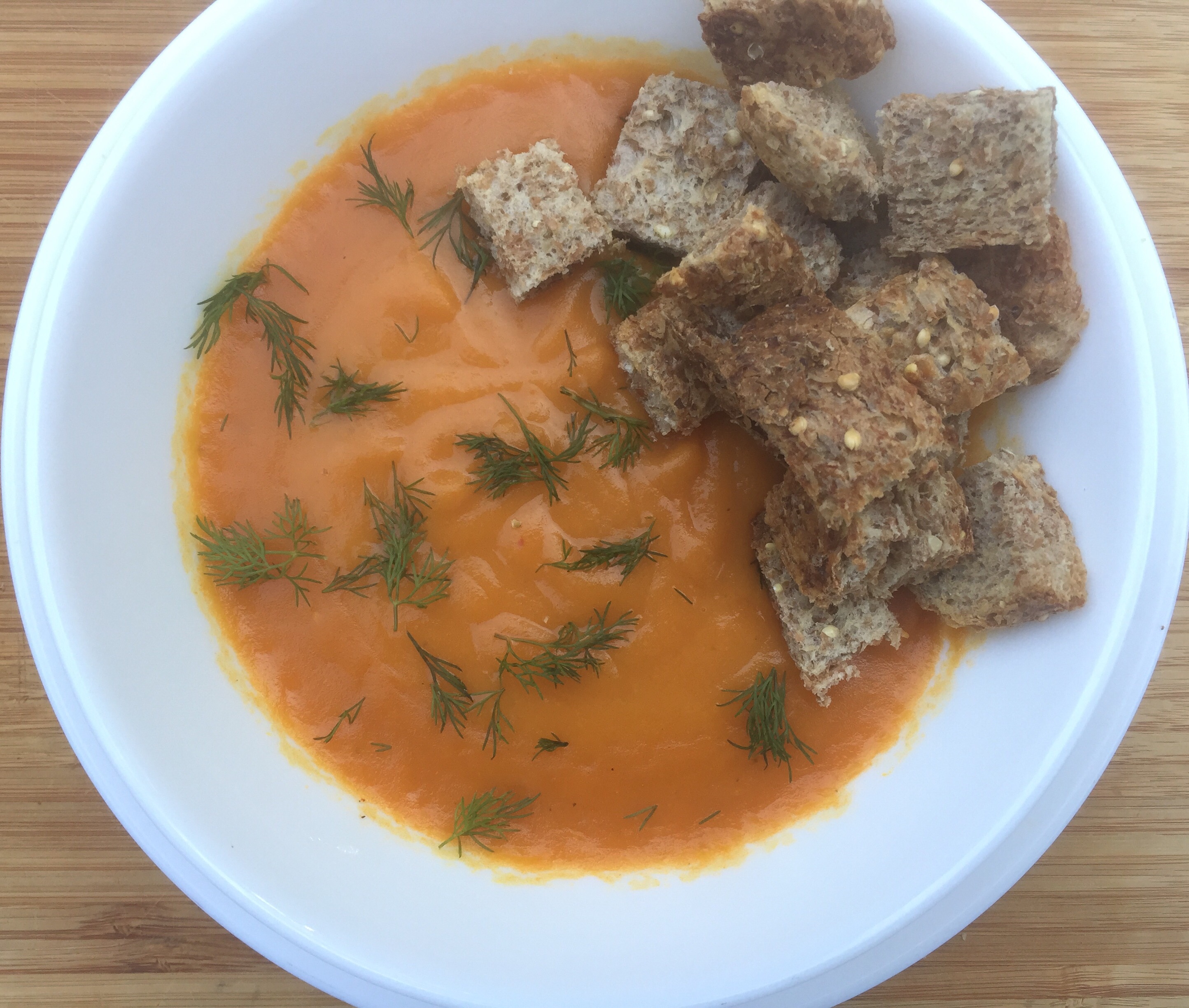
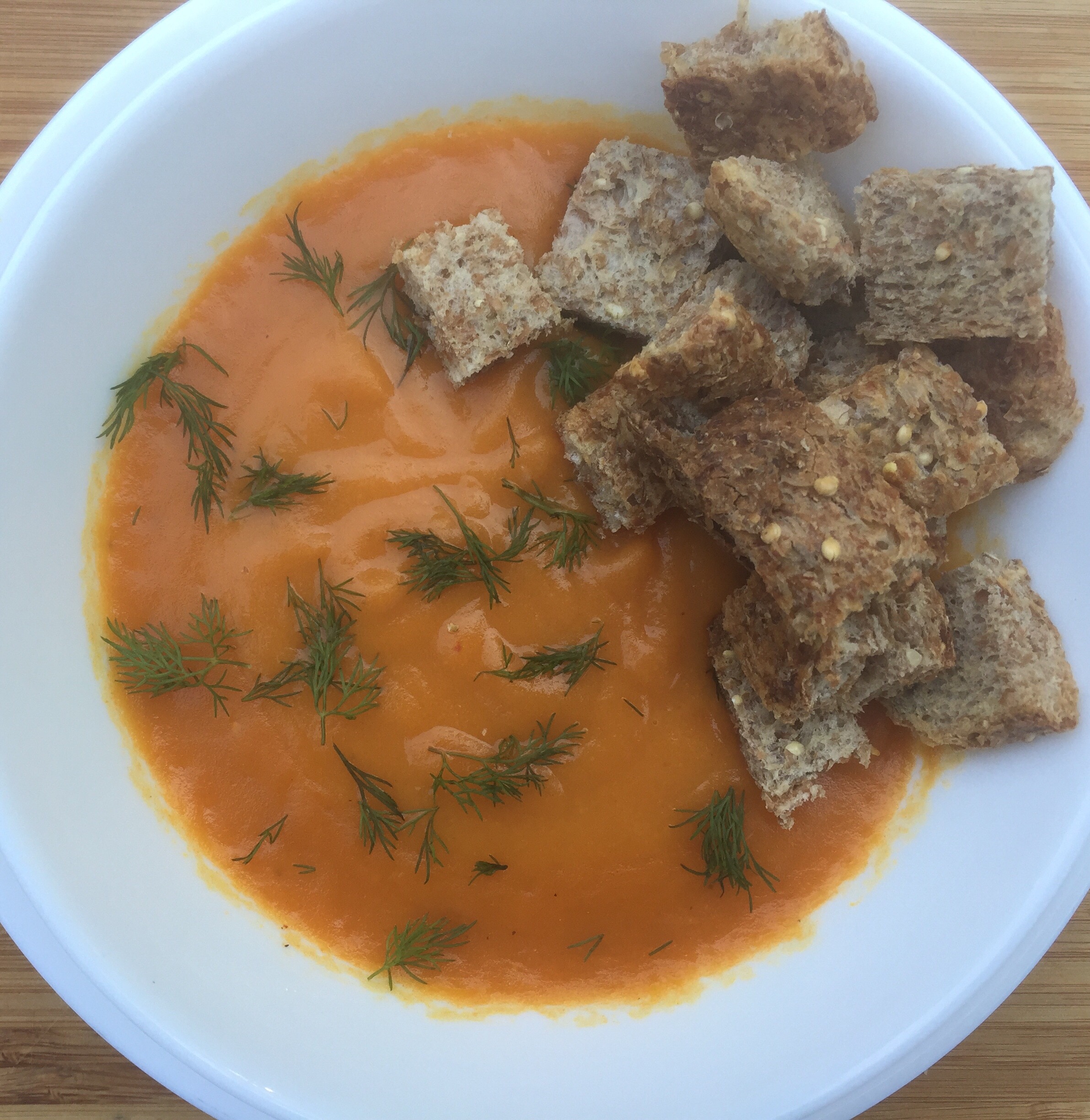
Cream of Carrot Soup


Cream of carrot? How can that be? Well, it can, and it is, and you will not believe how great this soup is. Carrots are the star, to be sure, but what gives the soup its rich creaminess (without any cream) are the white potatoes, and you want to pick nice, starchy potato variety, like the Russets.  The starchier the potato, the creamier the final soup. Usually, the really starchy potatoes don’t hold well to boiling and tend to fall apart. In this case that really does not matter because everything will go into a blender at the end. I do recommend you chop your carrots and potatoes into smaller chunks to speed up the cooking process, but they don’t need to be finely diced.

The potatoes and the carrots cook together with flavor agents, like soy sauce and the Worcestershire sauce, and the spices, like smoked paprika or smoked paprika flakes, garlic powder and ground mustard.  I also suggest you use vegetable stock and not water, because a really great stock will extend the richness of your flavors, while water will dilute them out. In terms of what stock to use exactly, you’ll have to try it out and see what you like. Reduced sodium options are probably the best starting point, and you can always taste a bit of the stock before dumping it into the pot. If the stock is not pleasant to drink, it will probably not make for a pleasant soup to eat. I would stay away from roasted garlic infused or very heavy on spices stocks and go with mild almost bland stocks that you can build on and that will not interfere with all the other ingredients you are using.

This soup is in many ways an extension of me using carrots for as many things as possible, including the summer hit – carrot dogs – and some of my baking, like cookies and muffins.

What helps put this soup over the top is just a sprinkle of fresh dill at the end, and a handful of freshly toasted croutons. With all that in place all that’s left to do is grab a spoon and dig in!

Cream of Carrot Soup

What you’ll need:

6 large carrots

2 potatoes, Russet or white

2 tablespoon oil

2 teaspoon ground mustard powder

1 tablespoon soy sauce

1 teaspoon Worcestershire sauce (vegan)

1 teaspoon steak sauce

1 teaspoon garlic powder

1 teaspoon smoked paprika flakes

4 cups vegetable stock

2 tablespoons dill, fresh


What you’ll do:

  1. Wash, peel and cube carrots and potatoes. Place in a pot, cover with water and boil for about 15 minutes, until vegetables are just soft but not falling apart.
  2. Drain the vegetables, pat dry to absorb as much of the access water as you can, and place in a large mixing bowl.
  3. Add the oil, spices and sauces and mix well. Let marinade for 30-60 minutes.
  4. Place all the vegetables and the marinade into a blender and add the vegetable stock. Blend until smooth and silky. You can do this step in the mixing bowl with an immersion blender but I think the regular upright blender produces smoother consistency.
  5. Pour back into the pot and bring to simmer. Let the soup simmer gently for 10 to 20 minutes.
  6. While the soup is simmering you can toast some bread, or make some croutons.
  7. Serve the soup with a sprinkle of fresh dill, and some toast, croutons, bread or even tortilla chips on the side. Mmmmm… good!!!

Copyright © Eat the Vegan Rainbow, 2017

Chestnut and Mushroom Stuffing for the Best Thanksgiving Dinner Ever

img_3602
Chestnut and Mushroom Stuffing, via Eat the Vegan Rainbow

If you think you can’t live without the traditional Thanksgiving dinner with the roasted turkey, mashed potatoes full of butter, the stuffing made with rich sausage, gravy made from turkey fat, sweet potato casserole topped with marshmallows, corn bread with cheese, pumpkin pie with vanilla ice cream, and so on and so forth, let me reassure you – you can give this all up, and replace it with an amazing and creative plant-based feast that celebrates the season and gives thanks for the bountiful harvest, our friends and families, and our beautiful and extraordinary planet.

I put together this menu as a testament that food can be colorful, flavorful, aromatic, and delicious without major time and money investment. This entire menu will cost you far less than the regular Thanksgiving feast, and instead of leaving you tired and sluggish, it will leave you filling energized and elevated… and ready for whatever Black Friday may bring!

Joking aside, this menu is meant for entertaining and for making a huge impression. As any well-structure feast, my Thanksgiving offerings begin with appetizers. And since the meal is supposed to go on for an hour or more, and includes two dessert options, I am going light with the appetizer spread. My tray includes couple of different types of olives, Roasted Beets Hummus, Baked Almond Feta Cheese, and pita chips. You can make the pita chips by slicing some pita bread into wedges, spraying them with some oil or cooking spray and letting them toast for couple of minutes until golden-brown. Or you can get them at a supermarket, like I did on this occasion.

Do remind your guests to take it easy with the appetizers, because what’s coming next is the most amazing soup ever, the Creamy Cauliflower Winter Soup that owes it’s creaminess entirely to puréed cauliflower. The soup is white with slight gold overtones, which in my view frames the season perfectly. Plus corn and peas give this soup some substance and fresh thyme sets the stage for herbs to come.

img_3507
Creamy Cauliflower Winter Soup, via Eat the Vegan Rainbow

Main course is a real harvest celebration, with fireworks of flavors and all the trimmings working together to feed the bodies and the souls. The main dish is a lovely Harvest Roast with cubed sweet potatoes, turnips, carrots, parsnips, apples and squash, lightly oiled and flavored with herbs of the season. Complementing the Harvest Roast is the Chesnut and Mushroom Stuffing (recipe below). Add to that a protein rich Quinoa with Roasted Cranberries and Pistachios and you have your self an amazing feast!

img_3592
Quinoa with Roasted Cranberries and Pistachios, via Eat the Vegan Rainbow

Last but not the least, the meal ends with a glass of Fizzy Cranberry Mocktail, and two desserts that pay homage to the traditionally served pies, pumpkin and apple. The desserts I feature are Pumpkin Truffles, inspired by the traditional pumpkin pie recipe and spices that go into it, and Pecan Apple Baklava with Orange Maple Syrup, which combines the best of pecan and apple pies into one ultra scrumptious dessert.

Have a thankful, wonderful, healthy and delicious Thanksgiving feast!!!


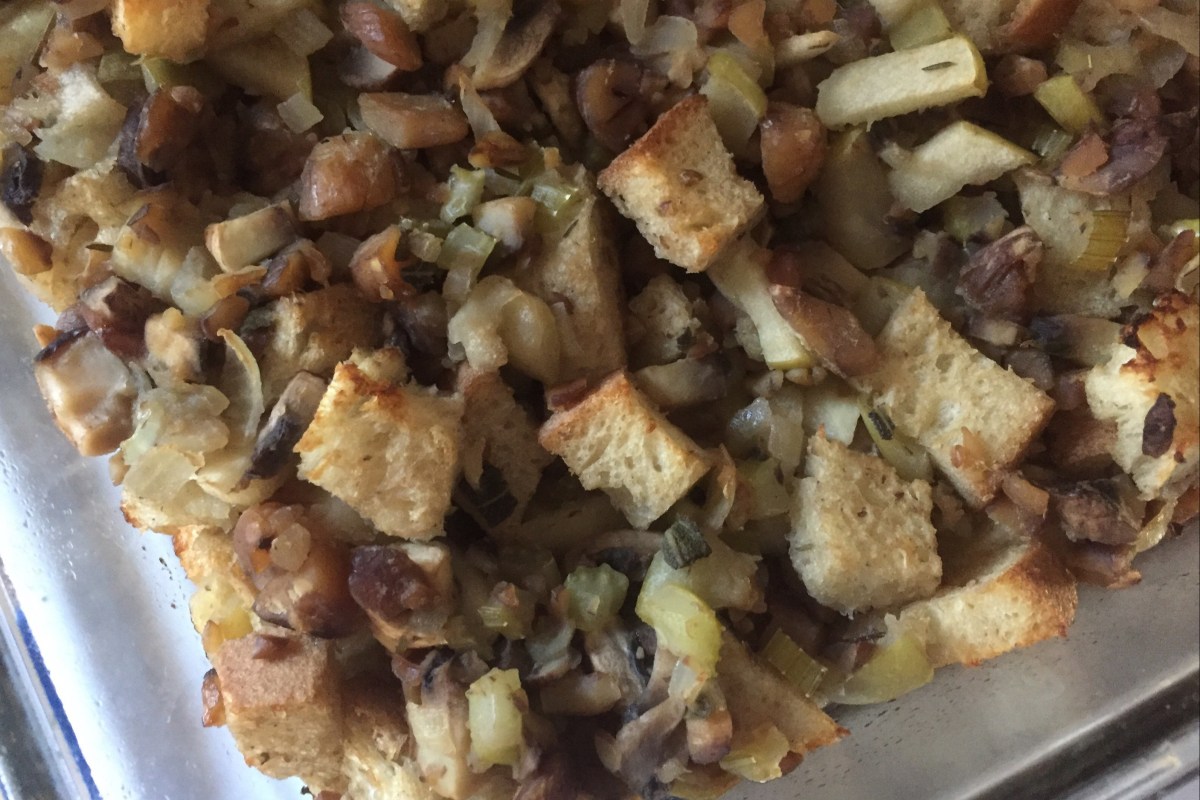
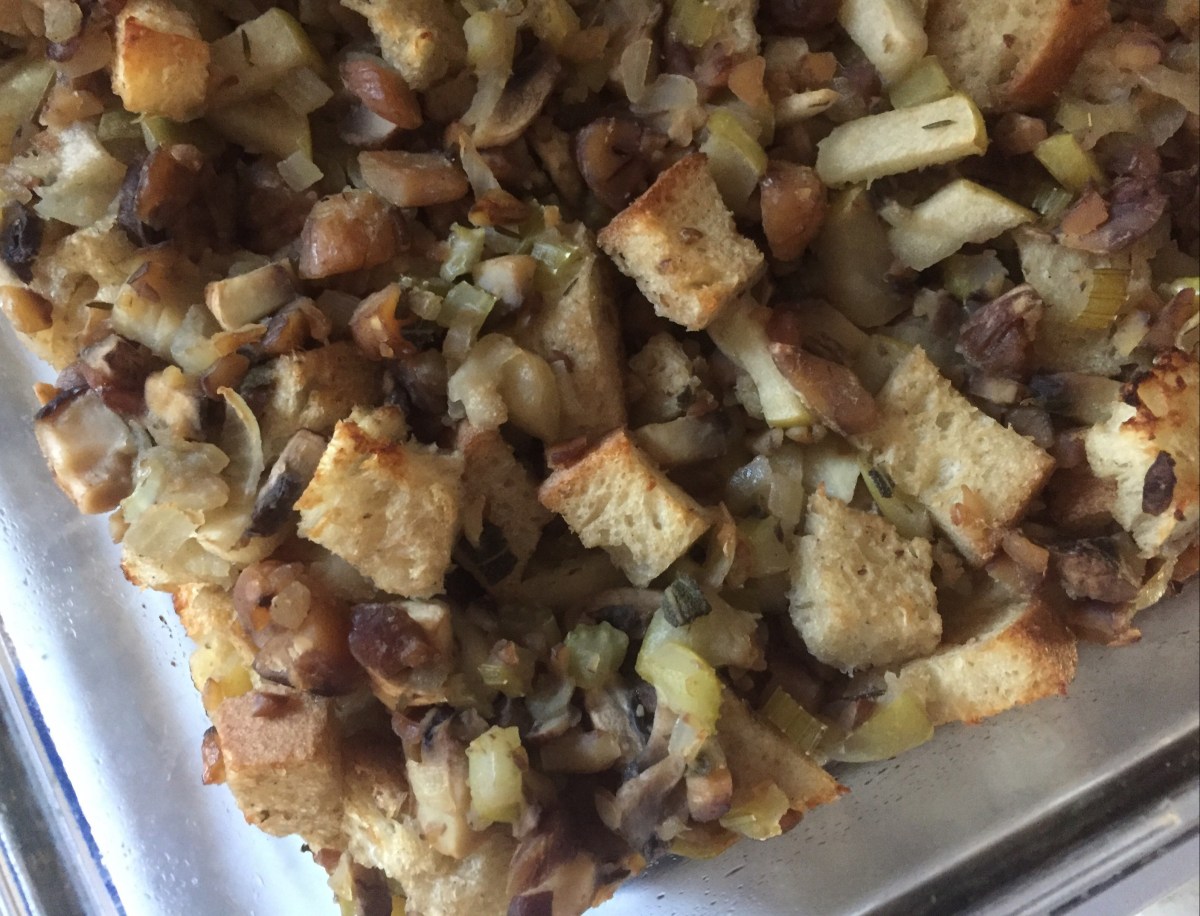
Chestnut and Mushroom Stuffing

What you’ll need:

1 yellow onion, finely diced

6 stalks celery, finely diced

2 Granny Smith (or another variety of tart) apples, diced

10 oz. (285 g) mushrooms, finely chopped (white, oyster, shiitake, baby bella – any combination of these will work)

10 oz. (285 g) chestnuts, boiled and chopped

4-6 slices of hearty sourdough bread (depending on the size of the slices)

Fresh sage, 4 leaves, chopped

Fresh thyme, 8 springs, pulled

Fresh rosemary, 2 springs, whole

Cooking spray

What you’ll do:

  1. One day prior to making the stuffing cut the bread into medium sized cubes, and leave them uncovered to dry. If you forget to do this a day ahead, don’t worry – you can cube the bread and put it in the oven to roast/toast. 10 minutes at 350 F (175 C) should be enough.
  2. Next day, place a large skillet over the medium-high heat. Add the olive oil, onions, celery and apple. Mix well and let it sauté with occasional stirring for 15 minutes.
  3. Add the mushrooms and two whole springs of rosemary (no need to chop, you’ll pull them out at the end), and continue sautéing for another 5 minutes.
  4. Add the chopped chestnuts, mix well to incorporate, and cook for another 10 minutes.
  5. Add chopped sage and thyme, mix in the bread cubes, and once everything is incorporated well transfer the stuffing to a large baking dish.
  6. Cover the stuffing with foil and bake for 20 minutes at 350 F (175 C), then remove the foil, bring the temperature to 400 F (190 C) and bake for another 10 minutes.
  7. Let the stuffing cool for 5-10 minutes before serving. The leftover stuffing, if you have any, can be an easy lunch on its own!!!

Copyright © Eat the Vegan Rainbow, 2017