New England “Clam” Chowder

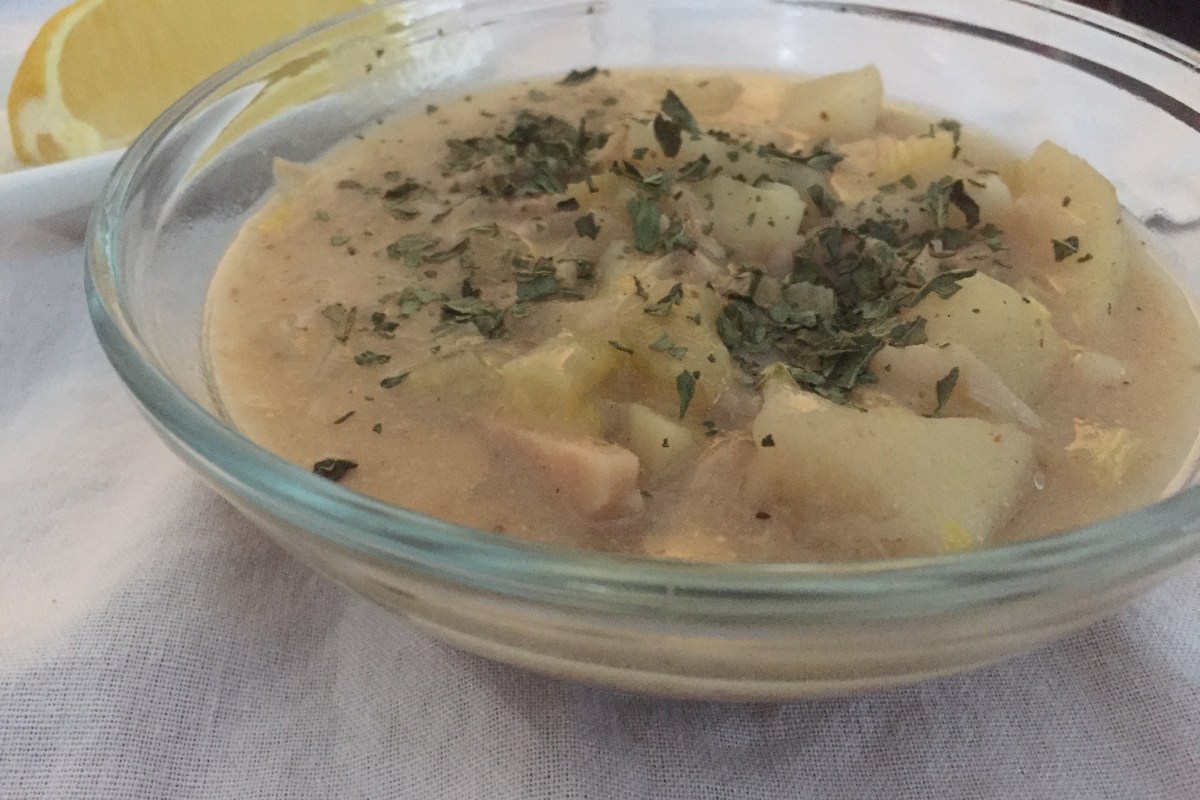
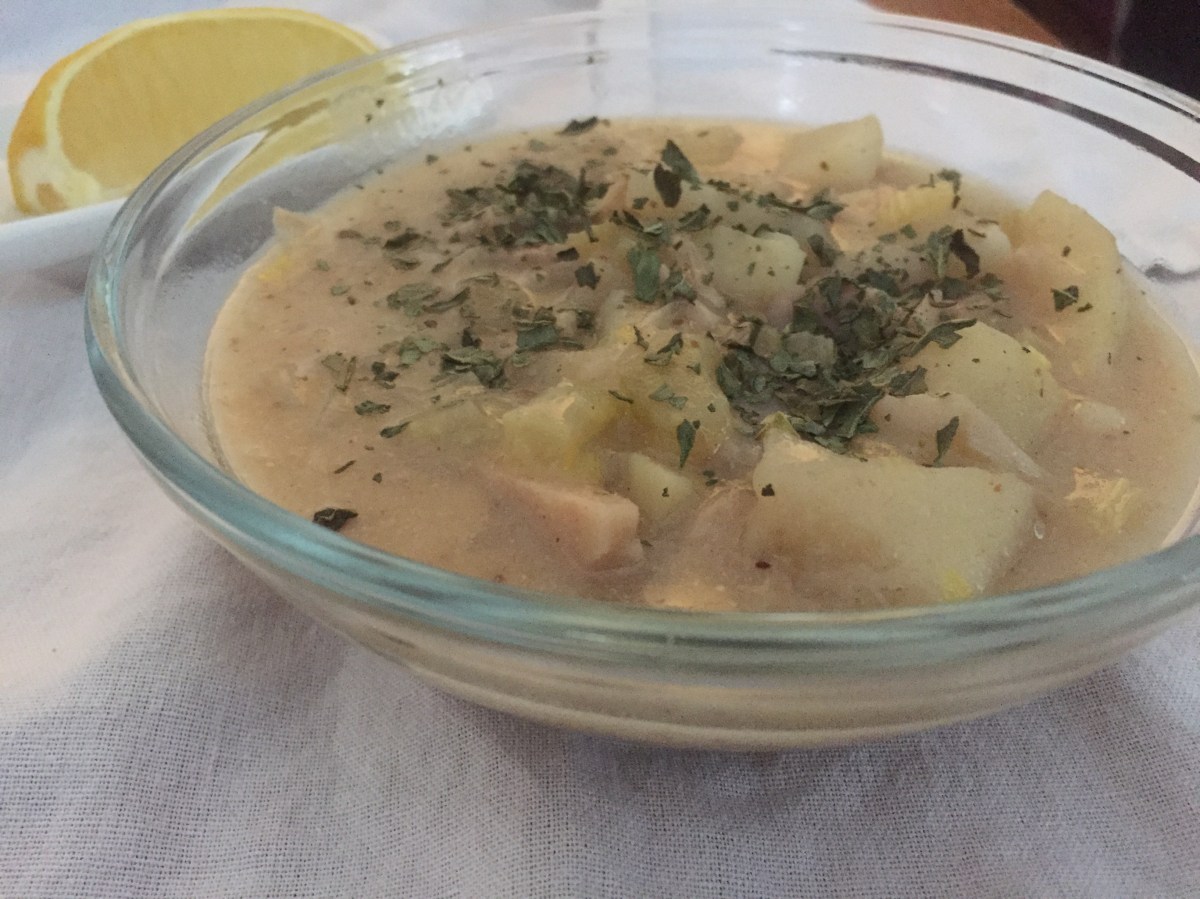
Bowl of New England “Clam” Chowder, via Eat the Vegan Rainbow

A week ago New England was thrown into a March snow storm that dumped 1-2 feet (30 – 60 cm) of fresh powder all over the region. Schools were closed, businesses advised people to work from home if they can, and by the time late afternoon rolled around we were all outside digging ourselves out.

As we all know, when it comes to the cold weather and snow storms nothing works faster to melt the chills away than a bowl of hot soup, so given the success of my Jackfruit “Crab” Cakes I decided to veganize a seafood classic, the New England Clam Chowder and see if jackfruit would work in this recipe as well.

For those of you not familiar with the New England Clam Chowder it is a creamy soup built from butter, heavy cream, celery, onions, potatoes, clam juice and clam meat. I had past success in making creamy soups using potato or corn starch as gluten-free thickening agents, and I was pretty sure that they will work here as well. I was interested to see how jackfruit will do as a stand in for clams and felt confident that it will turn out OK.

But how to make vegan clam juice, which is clam broth and a key ingredient in this soup that adds unique flavor evocative of sea and shell fish posed and interesting challenge. I decided to use some Old Bay Seasoning because it worked so well in my “crab” cakes, and for some extra sea flavor I used some seaweed broth. What I did is to soak two sushi nori seaweed sheets in some warm water for 30 minutes, and then pass the mix through a strainer to remove the seaweed and keep just the liquid. That was my “clam juice”, and it worked!

Beside that little neat trick, my one general recommendation is to use a Dutch oven or a similar heavy post with a lid, as the soup does need to simmer for a while. When the soup is done, it is best served fresh with a squeeze of lemon, coarsely ground (cracked) black pepper, a sprinkle of dry basil or fresh parsley, and a piece of bread. There’s nothing better to help you recover from all that snow shoveling!
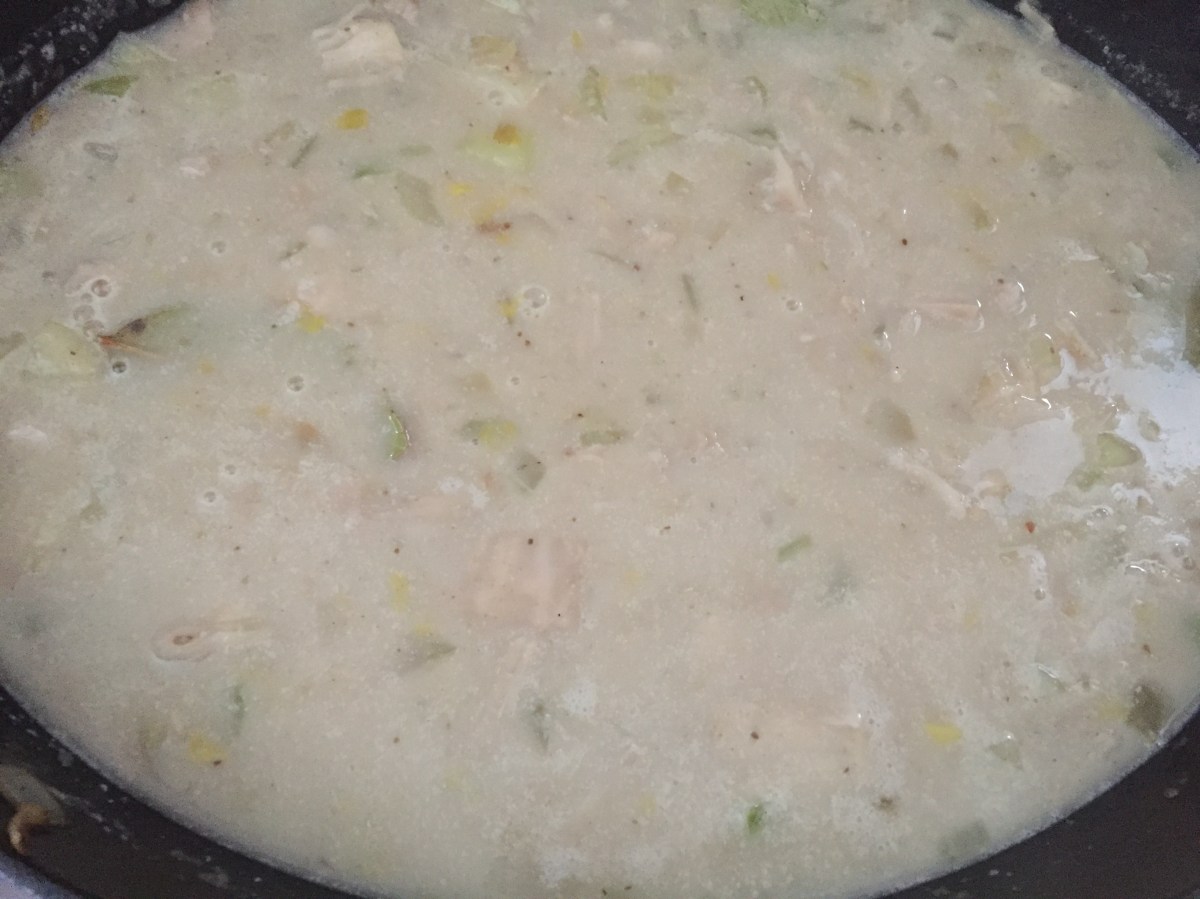
New England “Clam” Chowder, Gently Simmering, via Eat the Vegan Rainbow

New England “Clam” Chowder

What you’ll need:

1.5 lbs (700 g) potatoes, peeled and diced

1 can (10 oz, 280 g) young green jackfruit in brine

6 stalks of celery

1 large yellow onion

2 tablespoons garlic, crushed

1 tablespoon Old Bay Seasoning

3 tablespoons corn starch

2 tablespoons lemon juice

3 bay leaves

2 sheets of sushi nori seaweed

2 cups hot water

3 cups almond milk

Cooking spray

What you’ll do:

  1. Soak seaweed sheets in 2 cups of hot water for 15-30 minutes.
  2. While seaweed is soaking rinse and drain the jackfruit and pull the pieces apart to create smaller chunks, roughly the size and shape of chopped clams. Set aside.
  3. Peel and dice potatoes, onions and celery.
  4. Spray the bottom of a large Dutch oven, or other heavy pot, with cooking spray and bring up to medium high heat.
  5. Add onions, garlic and celery and sauté for 3-5 minutes.
  6. Add potatoes and continue sautéing for another 3-5 minutes.
  7. Add jackfruit, sprinkle with Old Bay Seasoning, mix well and sauté for another 5-7 minutes.
  8. While the vegetables are sautéing, run the seaweed through a strainer to remove as much seaweed as possible. You should end up with 2 cups of water that is slightly brown and smells like seaweed. That’s your “clam” juice
  9. Mix in the starch into the vegetables, and add the “clam” juice, bay leaves, and lemon juice. Bring the soup to gentle boil, mixing occasionally.
  10. Add almond milk, and keep the soup on gentle simmer for 20-30 minutes. Serve hot, with a squeeze of lemon and a piece of bread.

Copyright © Eat the Vegan Rainbow, 2017

Balkan Style Cornbread, Gluten-free and Vegan

Balkan Corn Bread
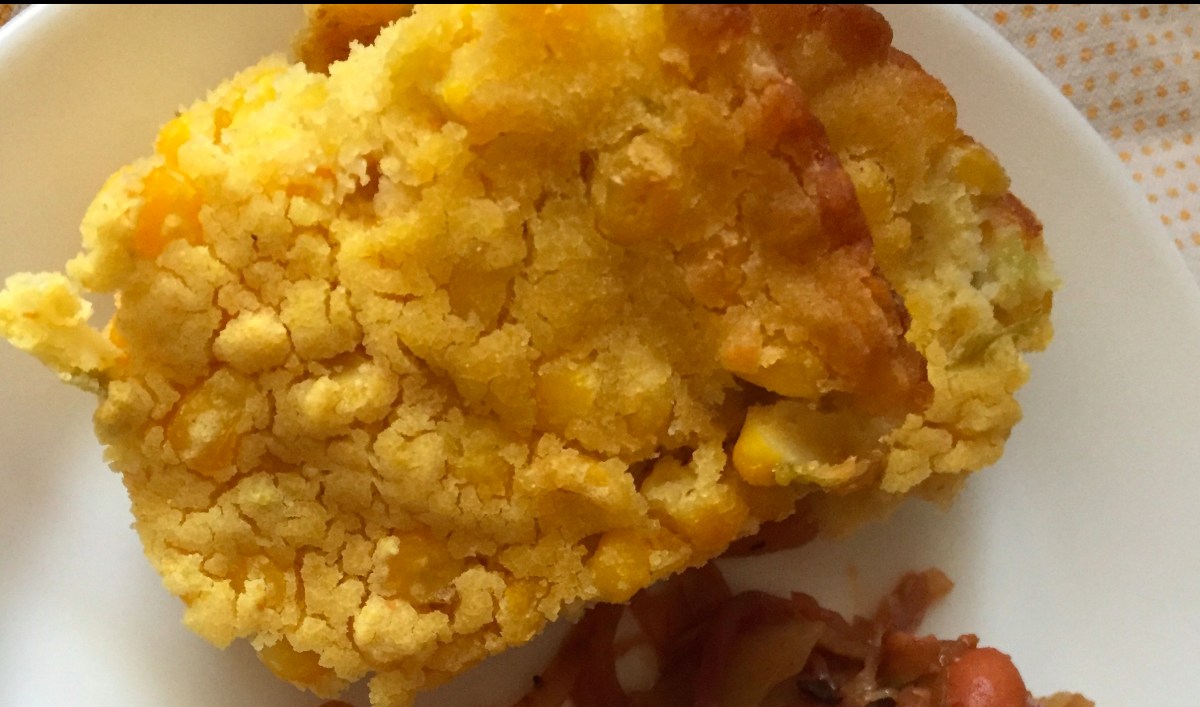
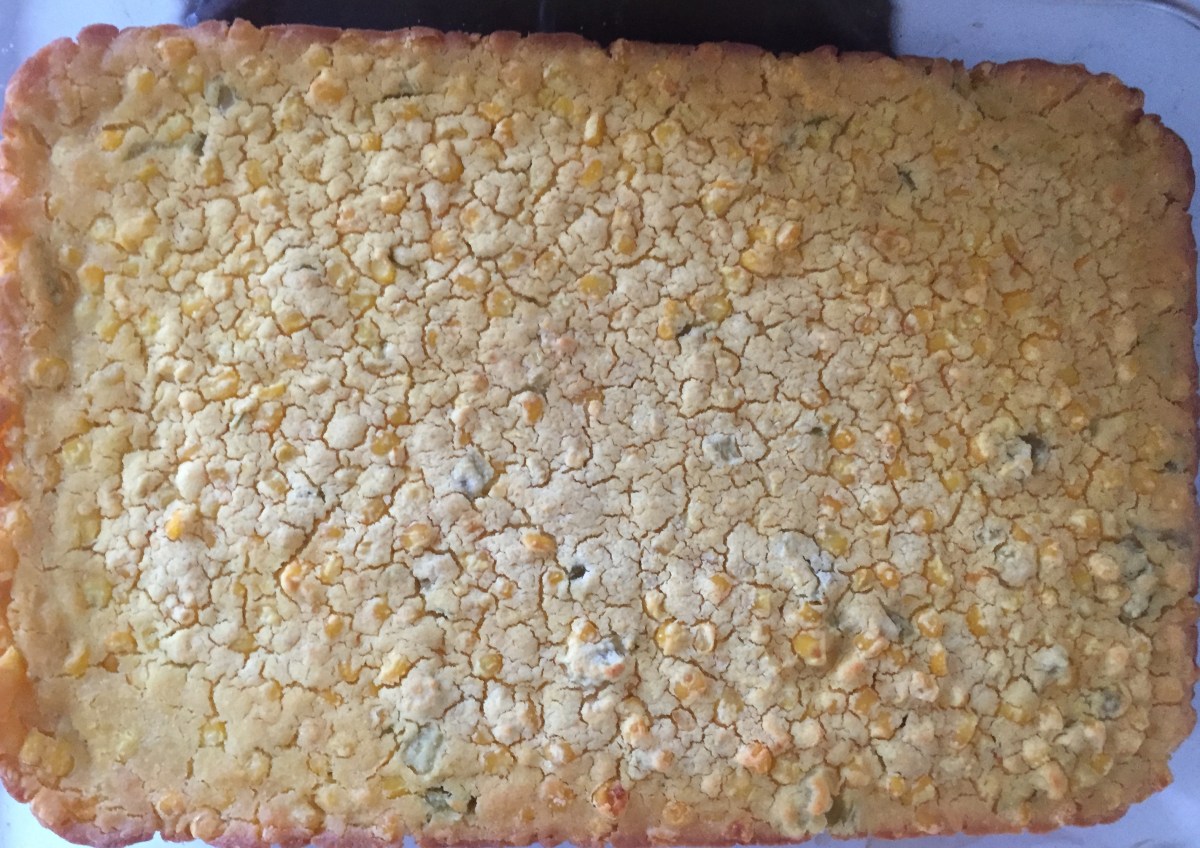
Balkan Style Cornbread, via Eat the Vegan Rainbow
Yesterday I shared the recipe for Balkan Cabbage and Bean Stew that I developed as a way of keeping my grandmother’s culinary traditions going in the 21st century. The very best, and also very traditional, side food for a sturdy Balkan dish featuring a pile of cabbage and beans is proja (pronounced pro-ya), a savory cornbread that is, in its pure form simple and subtle.  Think polenta but in sold form!

Over the years, recipes for proja have diversified away from using just corn flour, water, oil and baking soda, into more elaborate recipes that include eggs, cheese, yogurt, ham, and even pickles. I tried and enjoyed many of them, and they are delicious. But when it comes to pairing with a rich main dish, simpler is better. The recipe below is a relatively pared down but not-your-grandma’s Balkan style cornbread that is gluten-free and vegan.

I decided to add actual corn kernels to this recipe for a slightly more interesting texture. The corn I use is frozen corn that I defrosted on my kitchen counter top (you can always do it overnight in the fridge or quickly in the microwave). To jazz things up a bit I did add a can of fire roasted diced green chiles. You can totally skip this or add any other pepper you like if you are into a spicier version of the corn bread with a bit of kick!

Balkan Style Corn Bread
Balkan Style Cornbread, Gluten-free and Vegan, via Eat the Vegan Rainbow

Balkan Style Cornbread, Gluten-free and Vegan

What you’ll need:

1 1/2 cup corn meal, fine

1 1/2 cup rice flour

1/2 cup corn starch

2 cups kernel corn

1 can chili peppers

2 teaspoon baking powder

1 teaspoon baking soda

3 tablespoons  vegetable oil

2 cups water

Cooking spray

What you’ll do:

  1. Preheat the oven to 425 F (220 C).
  2. In a large mixing bowl combine all the ingredients except water. Add 1 cup of water and mix well. The cornbread batter should be wet but not too fluid, so I recommend adding the second cup of water in stages to make sure you don’t end up with a corn bread soup.
  3. Spray the bottom and the sides of a 13 x 9 in (33 x 23 cm) baking dish with the cooking spray.
  4. Pour the cornbread batter in, even it out and put it in the oven.
  5. Bake at 425 F (220 C) for 20 min then lower the temperature to 350 F (175 C) for another 20 minutes.
  6. Leave on the counter top for 10-15 minutes to cool, then cut and enjoy!

Note: This corn bread tastes great warm but if you don’t finish the entire cornbread immediately I recommend taking it out of the baking dish and storing in an air tight container in the refrigerator for up to 5 days. You can reheat it in the toaster oven or zap it for 30 sec in the microwave oven.

Copyright © Eat the Vegan Rainbow, 2017

Mashed Potato Stuffed Mushrooms with Cashew Sour Cream

Mashed Potato Stuffed Mushrooms with Cashew Sour Cream
Mashed Potato Stuffed Mushrooms with Cashew Sour Cream, via Eat the Vegan Rainbow
Fully loaded vegan mushrooms are finally here! Last time I went grocery shopping large white stuffing mushrooms were on sale and they looked so inviting that I had to have them. For most vegetarians and vegans mushrooms are a common ingredient as they add that elusive umami flavor to dishes. I used them fairly often and have featured them in  my Vegan Stuffed Pepper recipe.

This time around it is the mushrooms that are getting stuffed, and the stuffing I decided to go with is yummy, silky smooth and creamy mashed potatoes. Additionally, just to kick it up a notch I made some Cashew Sour Cream by Oh She Glows to add a bit of flair. Finally, sun dried tomatoes on top are for loveliness, color and for a bit of sweetness.

There are really two tricks here. One is to bake the mushroom caps on their own, and the other is to use a blender to purée the potatoes.

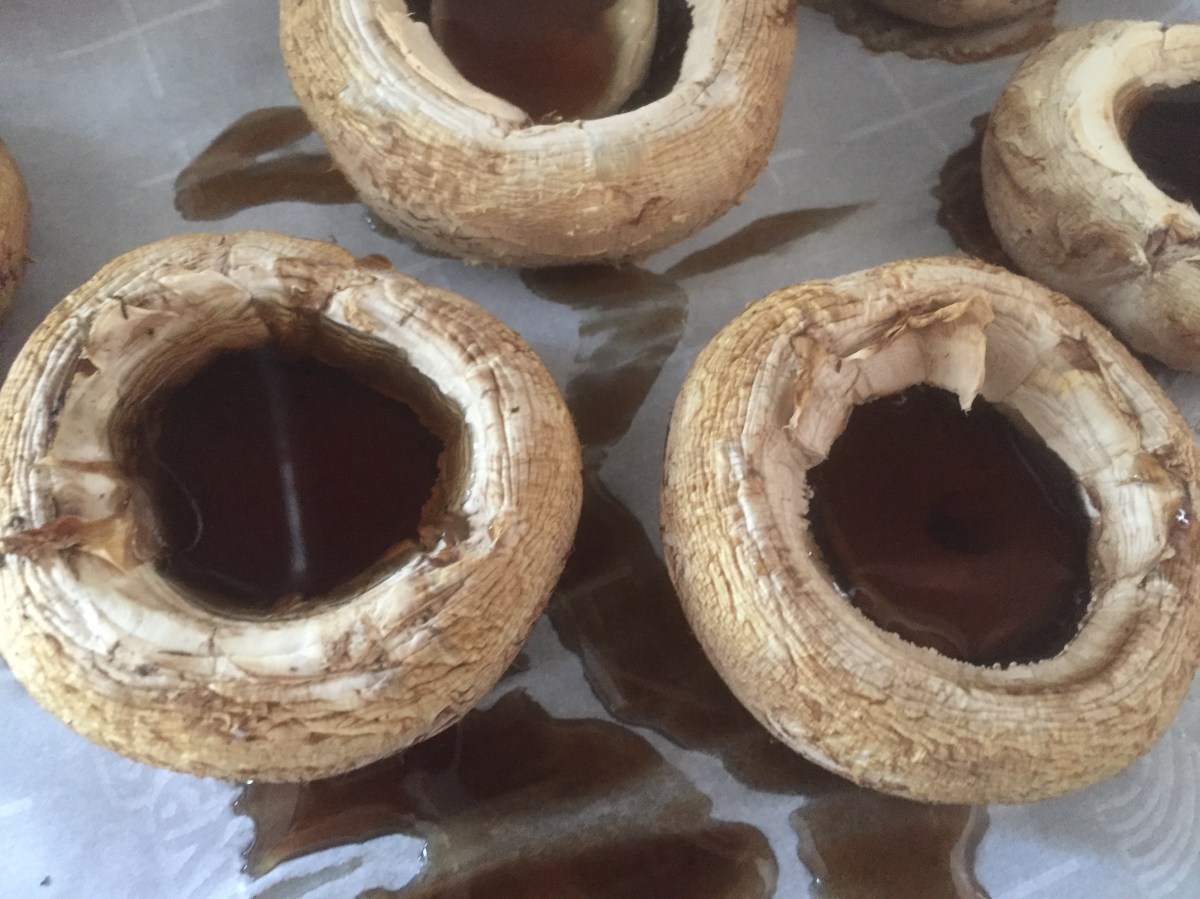
To get your mushrooms going I first remove the stems, but I don’t throw them away  as I use them as a part of the stuffing. I place mushroom caps their open ends up on the parchment paper (or foil) covered baking sheet and put them in the oven for about 20-30 minutes. The point is to get the caps soft and to let the mushrooms release excess water. At the end of the baking each mushroom cap should be filled with brown liquid (see below), and I dumped this liquid out. Transfer your mushroom caps into a greased baking dish with tall sides that will help with making sure no stuffing gets out while baking.

Baked Mushrooms, Ready for Stuffing
Baked Mushroom Caps, Ready for Stuffing, via Eat the Vegan Rainbow
Using a blender to purée the potatoes makes them into a creamy heaven that is perfect for stuffing. I would not recommend using the blender method if your end point is mashed potatoes because what you get is quite smooth, but for topping something like a Vegan Shepherd’s Pie or stuffing these mushrooms this method is perfect.

All in all these Vegan Mashed Potato Stuffed Mushrooms with Cashew Sour Cream are perfect as an interesting appetizer and entertaining, as well as a really great dinner in their own right. The amount of mushrooms I used is huge and it was definitely meant for sharing and enjoying in a large group, so feel free to scale down accordingly!

Vegan Mashed Potato Stuffed Mushrooms with Cashew Sour Cream

What you’ll need (for a 12 servings):

2 24 oz. (680 g) boxes white mushrooms, large

4 medium Russet potatoes

6 scallions

1/4 cup almond milk, plain & unsweetened (or other non-dairy milk)

1 cup of Cashew Sour Cream

1/3 cup sun dried tomatoes, julienned

Cooking spray

What you’ll do:

  1. Preheat oven to 350 F (180 C).
  2. Clean the mushrooms gently with a piece of paper towel. Separate stems from the caps. Keep the stems for later. Place caps, hole side up, on a parchment paper lined baking sheet and bake for 15-20 minutes, until the mushroom caps are soft and full of clear, brown liquid.
  3. Take the mushroom caps out the oven, discard the liquid and place them into a deep baking dish well sprayed with the cooking spray. Put aside.
  4. Peel the potatoes, chop them into small cubes and boil until cooked through which can take 15-30 minutes depending on the size of your cubes. Drain the water and let the potatoes cool for 15 minutes. Add almond milk and blend until potatoes are smooth.
  5. Chop scallions, using both the green and white parts, and mushroom stems finely.
  6. Spray a frying pan with cooking spray and sauté scallions and mushroom stems fro 5-10 minutes. Add sautéd scallion and mushroom stem mixture to the potatoes. Mix well.
  7. Spoon the potato mix into mushroom caps and top with a spoonful of cashew sour cream and few slices of sun dried tomatoes. Return to the oven for another 15 minutes.
  8. Bon appétit!

Copyright © Eat the Vegan Rainbow, 2017
Red Curry with Sweet Potatoes & Zucchini

VeganRedCurry_04
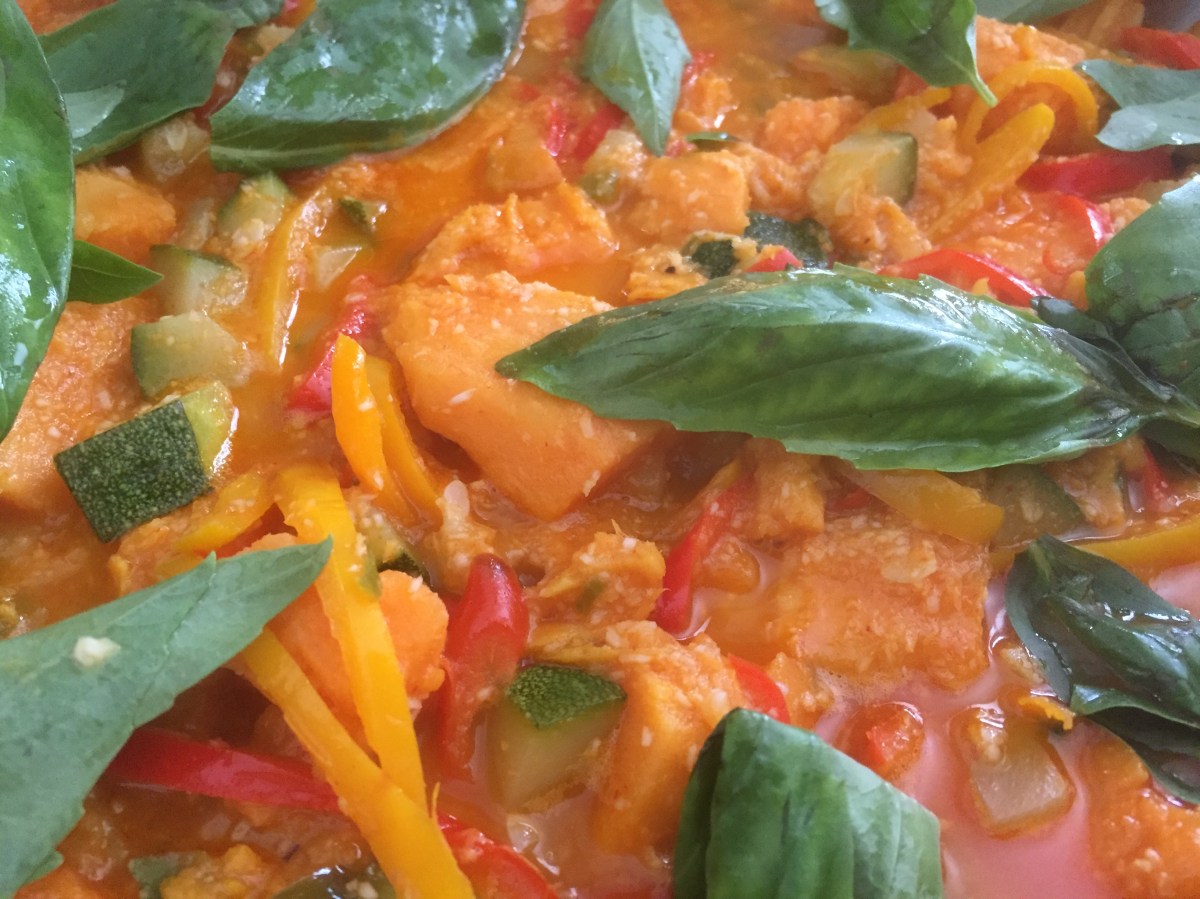
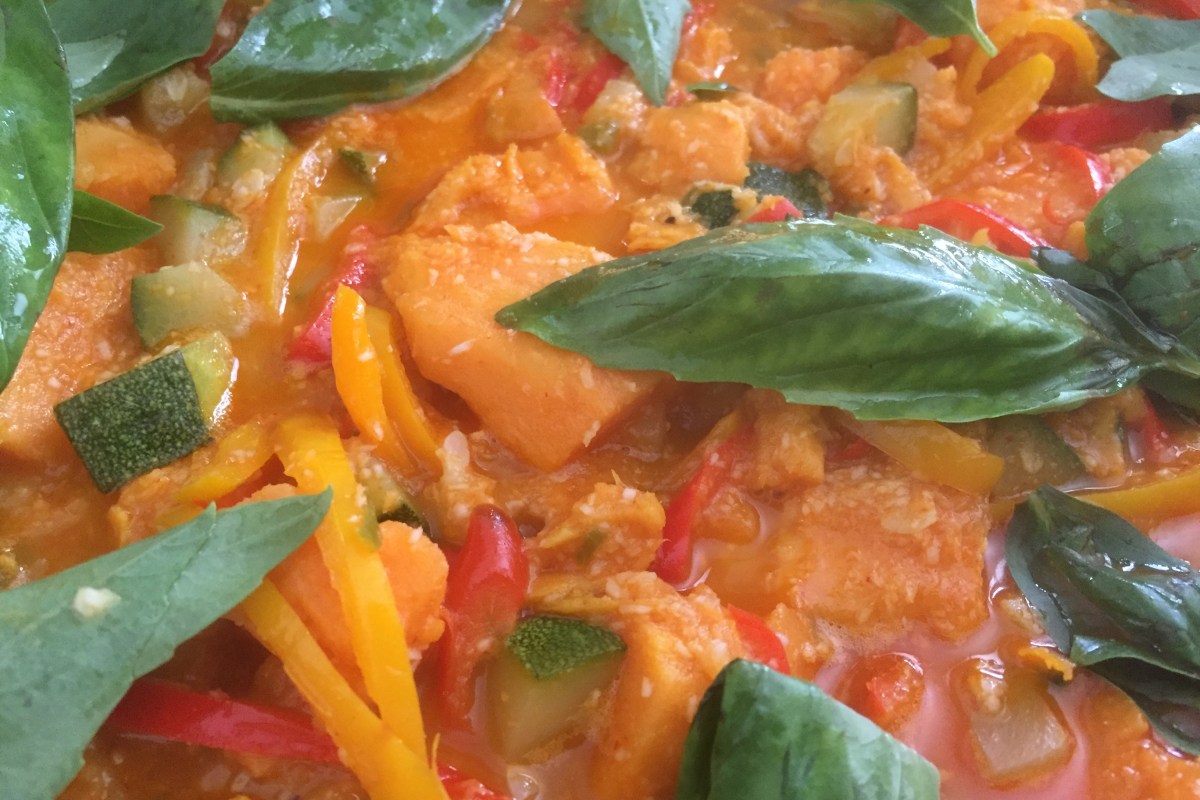
Vegan Red Curry with Sweet Potatoes and Zucchini, via Eat the Vegan Rainbow
I do like strong and bold spices, and food that is full of flavors yet not overpowering. So I gravitate towards Indian cuisine as you may have been able to tell given that I’ve already shared my vegan take on Chicken Tikka Masala and Saag Paneer. Another style of food that I enjoy comes from Southeast Asia, and I’ve been experimenting with Thai and Vietnamese recipes in the past. Most of those recipes do involve some animal ingredients so I wanted to try my hand at testing out the idea that Thai can be vegan.

My first stop on this journey is this Red Curry. You can make your own curry paste but Thai Kitchen Red Curry Paste is inexpensive, gluten free and vegan. It worked really well in this recipe so for now I am sticking with it!

In my view the secret to a great Red Curry is to go bold and diverse with your vegetables, and chop them in different ways so that your curry has some interesting color as well as texture. Here I use several different kinds of peppers, sweet potatoes and zucchini. You can use any kind of pepper you have handy. On this day in my kitchen I had a bag of mini sweet peppers that came in two colors, red and orange. I also got some shishito peppers that I’ve never used before but I figured it’s OK to be adventures. At the end, the shishitos turned out to be mild and did not overpower the flavors but I did remove all their seeds before using, which may have reduced any heat they would have brought in. If you do like your curry’s hot, you can use chili peppers, or other varieties with more heat.

VeganRedCurry_02
Peppers and Zucchini for Vegan Red Curry, via Eat the Vegan Rainbow
Final tip that I think makes a big difference is cooking the sweet potatoes almost all the way through before adding them to the curry. I cooked mine, skin on in the microwave and they came out perfectly sweet and delicious. What also makes a huge difference is using fresh basil and adding it at the very end so that it has just enough time to release its aroma without getting cooked.

Vegan Red Curry with Sweet Potatoes and Zucchini

What you’ll need:

2 large sweet potatoes, skin on

2 large zucchini, unpeeled

6 mini peppers, orange

6 mini peppers, red

4 shishito peppers

1 13.5 oz (400 mL) can light coconut milk

3 tablespoons shredded coconut, unsweetened

2 tablespoons red curry paste (like Thai Kitchen)

10 basil leaves, fresh

Cooking spray

What you’ll do:

  1. Wash the sweet potatoes and put them in a large, microwave safe dish with 1/2 cup of water. Put the lid on, but don’t close all the way. Cook on high in the microwave for 10 minutes. Let stand for 15-20 minutes. Make sure sweet potatoes are cool enough to handle before you peel them. Chop the potatoes into 1 in x 1 in (2.5 cm x 2.5 cm) cubes. Set aside.
  2. While sweet potatoes are cooking and resting, chop the zucchini and the peppers. You want zucchini chopped into small dice, and red and orange mini peppers into thin matchsticks. Clean the seeds out the shishito peppers and chop them very finely.
  3. Spray the bottom of a large pan with cooking spray and heat on medium-high. Add all the peppers into the pan at once. Sauté for 10-15 minutes, until peppers are soft and their edges start to get brown.
  4. Add diced zucchini and sauté for another 5 minutes, until zucchini is cooked about half way through.
  5. Add curry paste, stir well and let sauté for another 5 minutes.
  6. Add coconut milk and coconut shreds, and cook for another 5 minutes.
  7. Add sweet potatoes. Mix well, lower the heat and simmer for 15-20 minutes. Turn the heat off, add fresh basil, and let stand for 5 minutes.
  8. Serve with rice, like the Saffron Brown Basmati Rice, or without it!

Copyright © Eat the Vegan Rainbow, 2017
Gluten-free Vegan Spaghetti & Meatballs

VeganMeatballs_withZucchiniSpaghetti_DONE
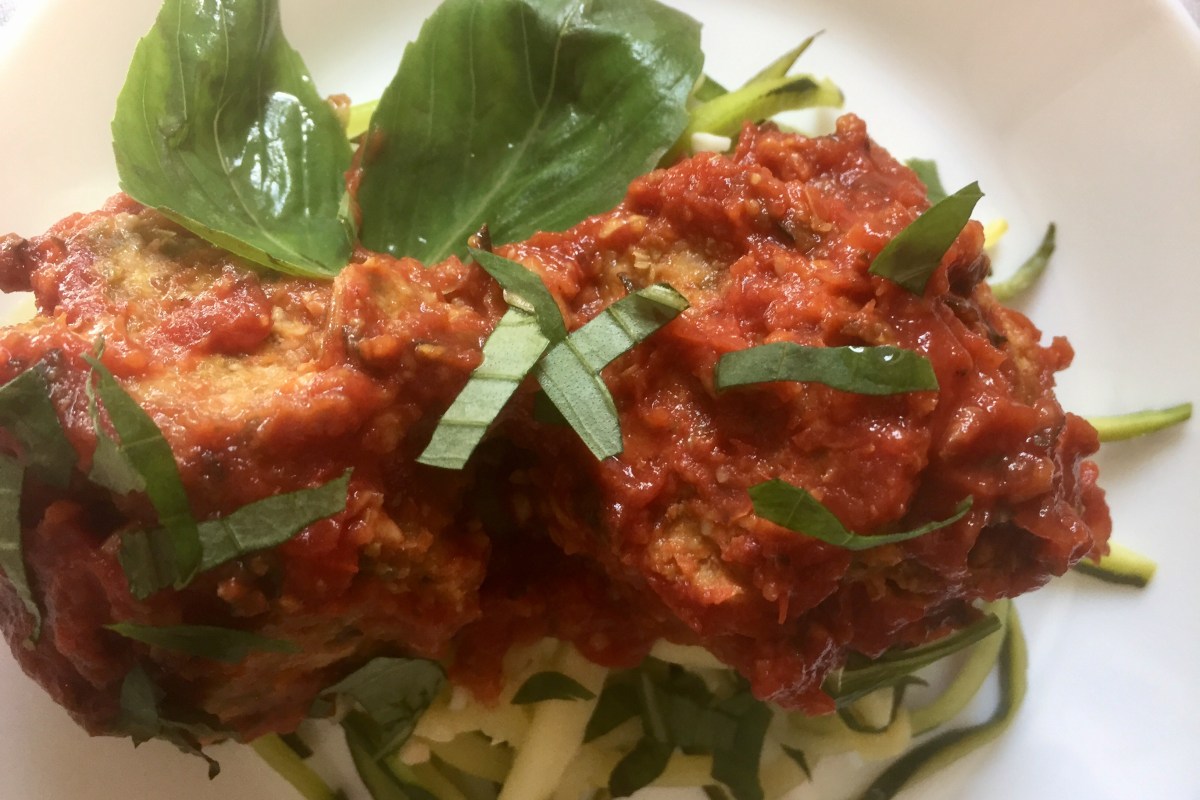
Gluten-free Vegan Spaghetti & Meatballs, via Eat the Vegan Rainbow
Can gluten-free, vegan cooking be budget friendly, healthy, feed the whole family, and yet leave everyone feeling they are getting away with something? The answer is yes, and this recipe is my evidence. I use no fancy ingredients, and no fancy techniques.

How did I end up here? Well, as they say “Necessity is the mother of invention”. What happened is that I found myself facing a large bag of frozen vegetable mix, which I have cooked with many times before never to any great success. This is a classic item you can find in any grocery store – a bag that includes unspecified amounts of frozen peas, corn, green beans, carrots, and lima beans. The price on these is usually too hard to resist, and they keep really well if kept frozen so I usually have a couple in my freezer in case of an emergency where all other options dry up.

So one of those emergency situations came up and this time around, perhaps because of all this blogging I’ve been doing recently, I had a real brain wave. I decided to transform the relatively amorphous tasting vegetable mix into really incredible vegan meatballs, or should I say veggie balls?

VeganMeatballs_01
Frozen Vegetable Mix, thawed, via Eat the Vegan Rainbow
There are couple of simple tips that when put together make this recipe work. First of all, thaw your vegetables don’t cook them! Depending on the amount of veggies you use this may take 5-10 minutes in the microwave on high. Once the veggies are thawed and soft all through, use a stick (immersion) blender, or a food processor to make a thick paste out of it all. This will be a base for your “meatballs”.

Another thing that you will need to do is add flavor to the mix. Although each one of these veggies is lovely on their own and when fresh, put all together and after freezing and thawing they do lose some of their flavor. My secret ingredient in this recipe is definitely a dash of Trader Joe’s Chile Lime Seasoning Bland. If you don’t live in the area with a handy Trader Joe’s store near by, you can use regular chili powder and add some lime or lemon zest – that will do the trick!

You will have to be a bit patient with this recipe as it does take a bit of time. First of all, I use oats to help the meatballs stick together. I did not leave the oats whole, rather I blended them all into the veggie mix using a stick blender, added the spices, and left the mix to sit for about 15 minutes. That gives oats some time to absorb the liquid and make the mix stick together better, which helps for the next step – forming the “meatballs” and browning them. I recommend using a Dutch oven to brown the “meatballs”, as well as simmering the rich tomato sauce.

VeganMeatballs_03
Vegan “Meatballs” Browned in a Dutch Oven, via Eat the Vegan Rainbow
One word of advice is not to overcrowd your Dutch oven, and keep some room in between the “meatballs”. This helps them cook, and helps you maneuver them around. Once the “meatballs” are nicely browned set them aside and use the same Dutch oven for putting your tomato sauce together. I kept my recipe simple and my cost down by using canned crushed tomatoes and using some crushed garlic, dried oregano and dried basil to flavor the sauce. The sauce does not need to cook for long, and once it starts to simmer nicely and gently you can add the “meatballs” back.

VeganMeatballs_05
Vegan Meatballs in Tomato Sauce, via Eat the Vegan Rainbow
Don’t forget to lower the heat , bring the post to a very gentle simmer, and put the lid on! Without the lid you will soon end up with tomato sauce all over the stove top and the floor as this sauce does erupt in tiny little tomato sauce geysers.

To keep the recipe ultra healthy and gluten-free, I paired the meatballs with simple Zucchini Spaghetti.

Gluten-free Vegan Spaghetti & Meatballs

What you’ll need:

2 lbs (1 kg) bag of classic frozen vegetable mix

2 cups oats

1 tablespoon tomato paste

1 tablespoon soy sauce, reduced sodium

1 teaspoon garlic powder

1 teaspoon onion powder

1 teaspoon chili powder

1 teaspoon Trader Joe’s Chile Lime Seasoning Bland

1 1/2-2 28 oz (800 g) can crushed tomatoes

2 tablespoons crushed garlic

1 teaspoon dried oregano

1 teaspoon dried basil

Cooking spray

Fresh basil for serving

What you’ll do:

  1. Place the frozen vegetable into a microwave safe dish and microwave on high for 5-10 minutes to thaw the vegetables and slightly heat them through.
  2. Place the vegetables into a large mixing bowl. Use the stick blender to grind the vegetables into a relatively fine paste.
  3. Add oats and blend again.
  4. Add tomato paste, soy sauce, as well as onion, garlic, chili and lime chili powder. Mix well and let stand for 15 minutes or so.
  5. Spray the bottom of a large Dutch oven with cooking spray and bring to medium high heat. Use 1/4 cup or the ice cream scoop to scoop out the “meatball” mix and form the balls. Place them into the hot Dutch oven and let brown for 2-3 minutes. Turn the “meatballs” over and brown on the other side. Take them out of the Dutch oven and set aside. Spray with more cooking spray if needed and add another batch of “meatballs”. Continue until all your “meatballs” have been browned.
  6. Bring the heat up to high, add more cooking spray, and add crushed garlic and dried oregano and basil. Let it bloom, develop & release the aroma for 1-2 minutes. Add crushed tomatoes. Depending how much tomato sauce you’d like to have you may need to adjust the amount of crushed tomatoes you add. Bring the tomato sauce to a simmer and let it simmer for 5-10 minutes.
  7. Turn the heat way down and add back the “meatballs”. You will likely have two layers of meatballs which is fine, but it’s a good idea to keep in mind that they are relatively soft so treat them gently! Make sure they are nicely snuggled and covered by the sauce. Put the lid on and let the “meatballs” and sauce simmer for 15 – 20 minutes.
  8. When you are ready to serve, start with a generous amount of Zucchini Spaghetti, add couple of vegan meatballs, spread some sauce, and top with fresh basil. Enjoy!

Update: Few days ago I used the same “meatball” mix and made a “meatloaf” out of it. It worked really well!!! Here are couple of pictures to show you what it all looks like. One tip: bake the “meatloaf” on 375 F (190 C) for 25-30 minutes first, before putting on the tomato paste, then bake for 15 minutes more. Let the “meatloaf” stand for 15 minutes before cutting – the loaf will be soft when it comes out of the oven but it will firm up!

Copyright © Eat the Vegan Rainbow, 2017

Gluten-free Vegan Carrot Cake Muffins

GlutenfreeCarrotCakeMuffins_DONE
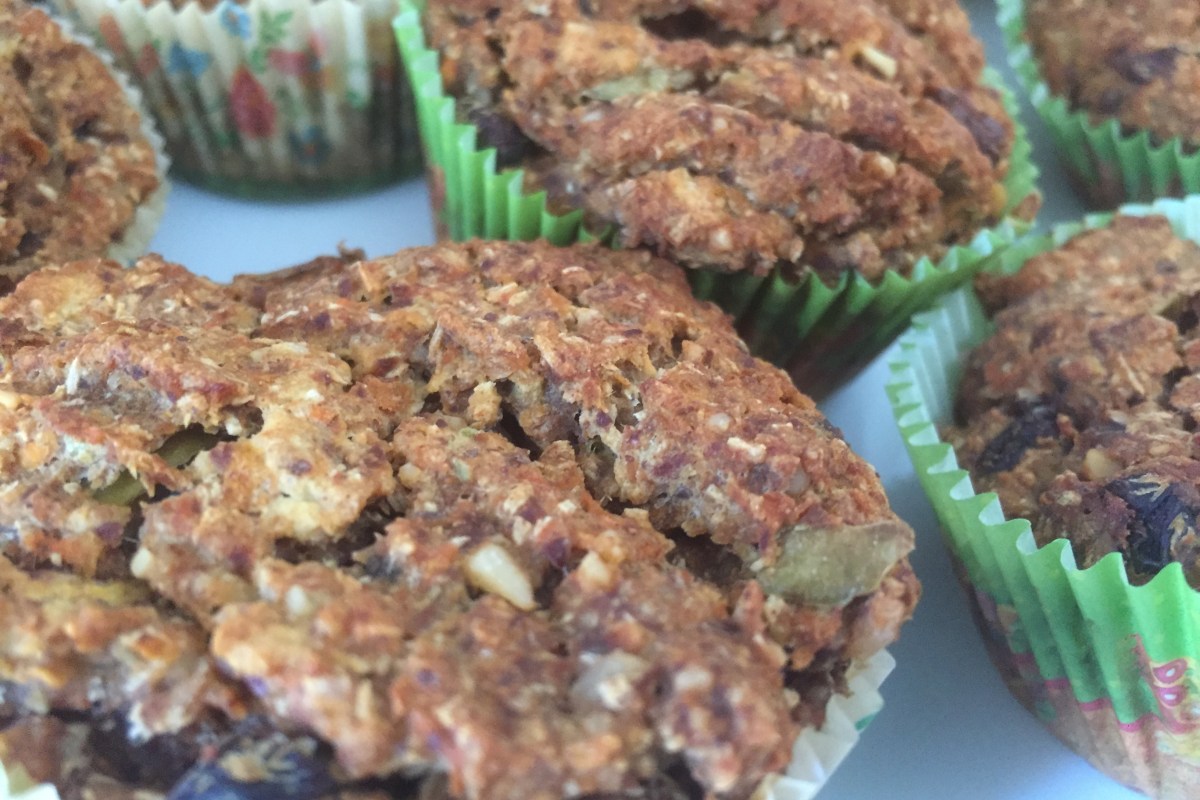
Gluten-free Vegan Carrot Cake Muffins, via Eat the Vegan Rainbow
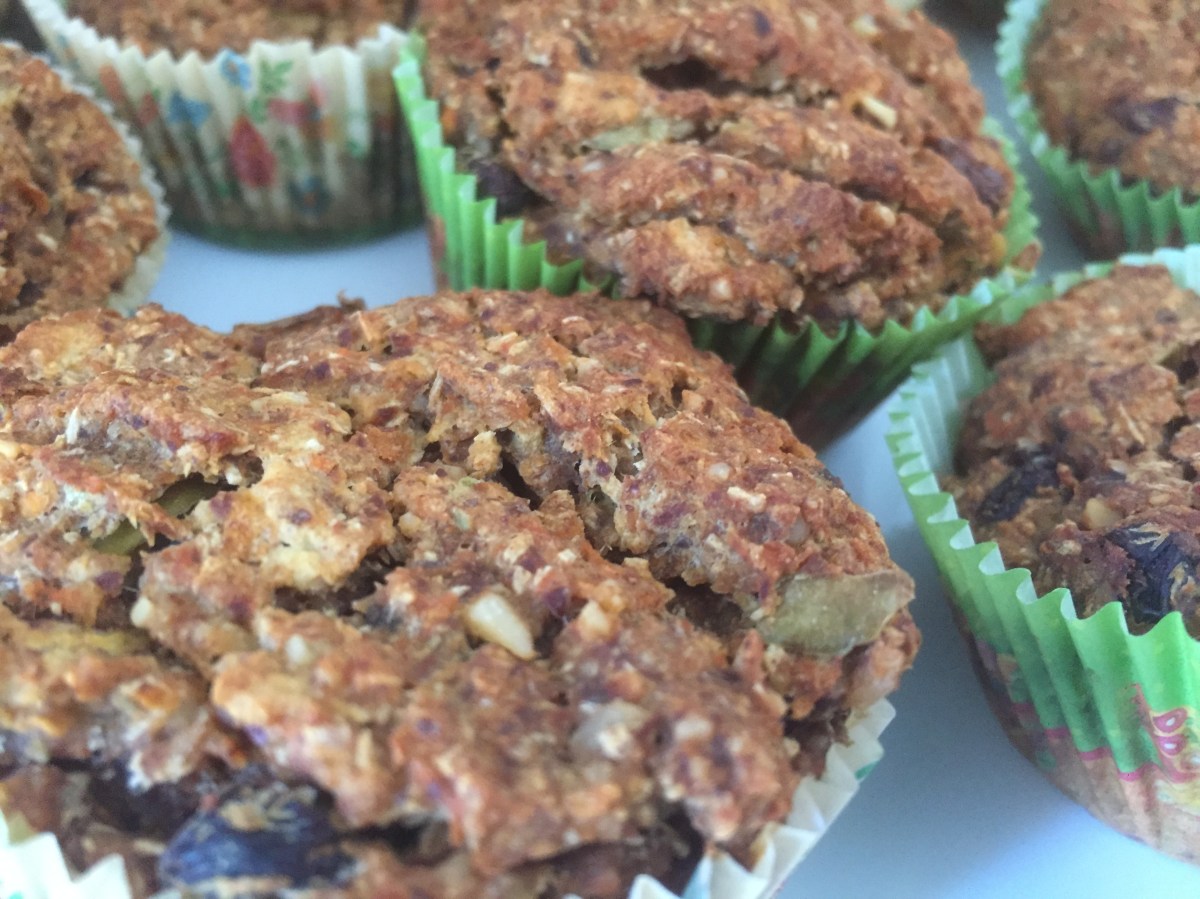
Baking does not come easy to me and gluten-free vegan baking is even more difficult. But, creating a recipe for carrot cake muffins that fits into my philosophy of vegan cooking with minimal amount of added sugar was hard to resist. This recipe is simple and uses simple ingredients like carrots, apples, walnuts, and raisins. It also uses couple of ingredients that make this gluten-free and vegan, like flex meal, rice flour, and tapioca starch.

The result is a recipe that is fun to make, and works well as a family activity that can teach very young children about measurements and mixing, as well as using some basic kitchen equipment. Because the recipe uses ingredients that don’t require cooking to be edible (like carrots, apples, raisins) and don’t pose any health risk, unlike common muffin recipes that use eggs, the recipe is very worry-free when it comes to licking the bowl and spatula, putting messy hands in the mouth, or other types of ad hoc tasting that young chefs gravitate to.

One tip for making this into a smooth sailing assembly line is to use the food processor to do most of the work, and start by chopping carrots, followed by apple, then move to walnuts. Additionally, starting the flex meal vegan egg mix prior to all the chopping is a good idea as well. Finally, the mix will be sticky so do spray your muffin tin liners with some cooking spray. It will help peel the wraps off, and has minimal impact on fat content or the baking process.

This recipe makes 12 large muffins, and each muffin is very filling so you may want to start here and scale up if you find the muffins irresistible (which you will!). Do these muffins need frosting? I don’t think so, but if you’d like some then a frosting with a hint of orange zest would work really well and build on a bit of orange juice that I use in the batter.

Gluten-free Vegan Carrot Cake Muffins

What you’ll need (makes 12 muffins):

3 large carrots

1 Granny Smith apple

2/3 cup walnuts

2/3 cup raisins

2/3 cup shredded coconut flakes, unsweetened

2 teaspoons cinnamon, ground

1/2 teaspoon nutmeg, ground

1 teaspoon baking powder

1 teaspoon baking soda

1/2 cup orange juice

1/2 cup rice flour

1/2 cup tapioca starch

2 tablespoons flex meal

6 tablespoons warm water

Cooking spray

What you’ll do:

  1. Preheat oven to 350 F (175 C).
  2. Mix flax meal with warm water and set aside for 15 minutes.
  3. Wash and peel the carrots. Using a food processor grind the carrots to a fine grind. Put the ground carrots in a large mixing bowl. Core (but don’t peel) the apple. Grind it to a fine grind and add to the carrots. Next, grind walnuts to a fine meal. Add to carrots and apple mix.
  4. Add the flex meal that has by now become a very gooey and viscous to the carrot-apple-walnut mix. Continue to add the rest of the ingredients except the orange juice. Mix well and check for consistency. The mix should be soft and wet, but not so fluid that it runs from the spoon. Use orange juice to adjust and go easy as you may discover that you need to use more or less than 1/2 cup I list here. The total amount will depend a bit on how large and juicy your apple is!
  5. Leave the mix to rest for 10-15 minutes.
  6. Line the bottom of your muffin tin with liners and spray with cooking spray. Fill them with 1/2 cup to 3/4 cup of the mix.
  7. Bake for 45-50 minutes then check for doneness using a toothpick. If the inserted toothpick comes out dry, you are done. If not, proceed for another 10-15 minutes.
  8. Take out of the oven and let rest for at least 30 minutes. If you plan to frost them let them cool completely before taking the next step. For a good vegan frosting recipe you can try one that uses coconut oil and add some orange zest for add kick!

Copyright © Eat the Vegan Rainbow, 2017

Quinoa & Cherry Tomatoes Stuffed Eggplant

stuffed-eggplant-done
Stuffed Eggplant with Quinoa and Cherry Tomatoes, via Eat the Vegan Rainbow
One could say that I am on the stuffing kick: I stuffed some peppers, made a Mexican lasagna, which is almost like stuffing corn tortillas, and played around a zucchini moussaka. Perhaps it is time to say enough is enough and move away from stuffing, but I just can’t. Stuffed things are simply too much fun to eat and so simple to make that I can’t let go. Plus, although you may think you’ve reached the point where there’s nothing new to try, a new idea pops into your mind and you simply have to pursue it.

This happened to me the other day when I returned home from grocery shopping with two nice and plump pieces of eggplant in my bag. For me eggplant is one of those vegetables that’s neither here nor there. It’s a bit complicated to make into something great and delicious, especially if you decide not to bread it, fry it, or stuff it with a ton of cheese – Eggplant Parmesan I am looking at you!

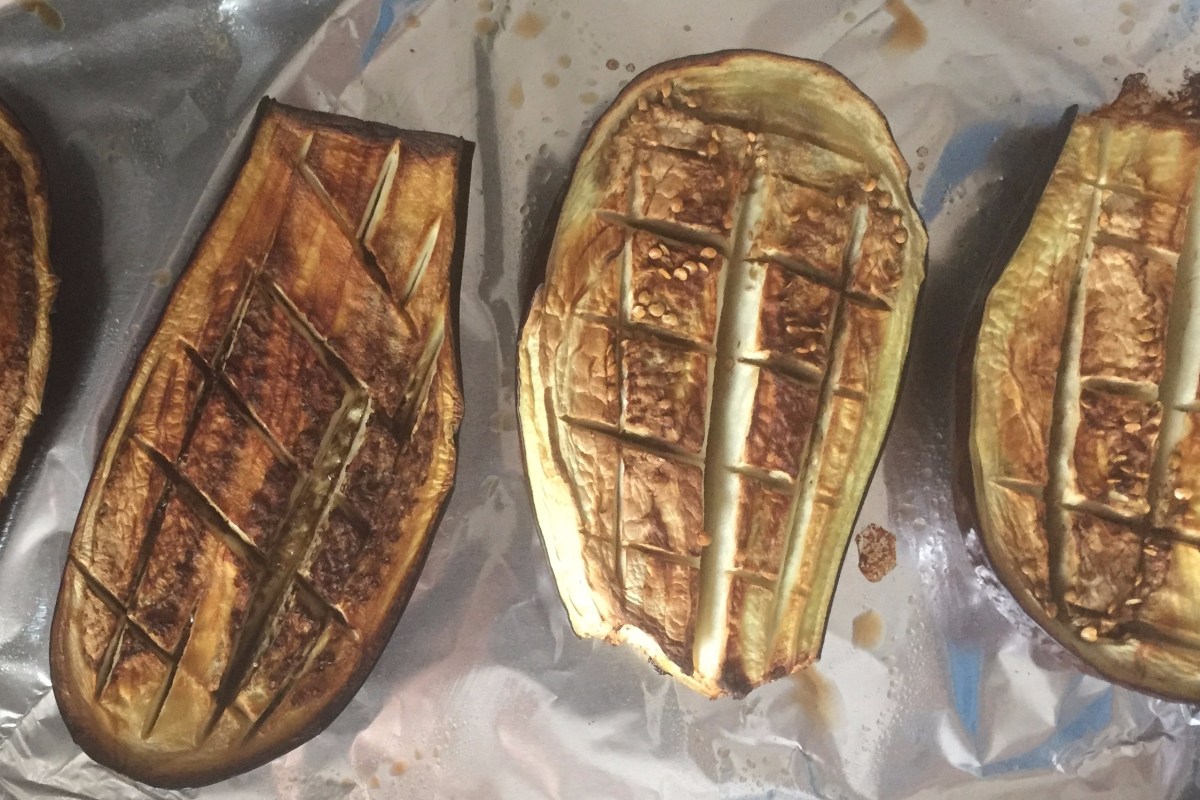
To make eggplant ready for stuffing and minimize the amount of oil needed to almost zilch, I decided to roast it first and then stuff it. Roasting does take a bit of time, although not too much as 20-30 minutes at 425 F (220 C) usually does the trick.

stuffed-eggplant-step-0
Roasting the Eggplant is the First Step En Route to Stuffing, via Eat the Vegan Rainbow
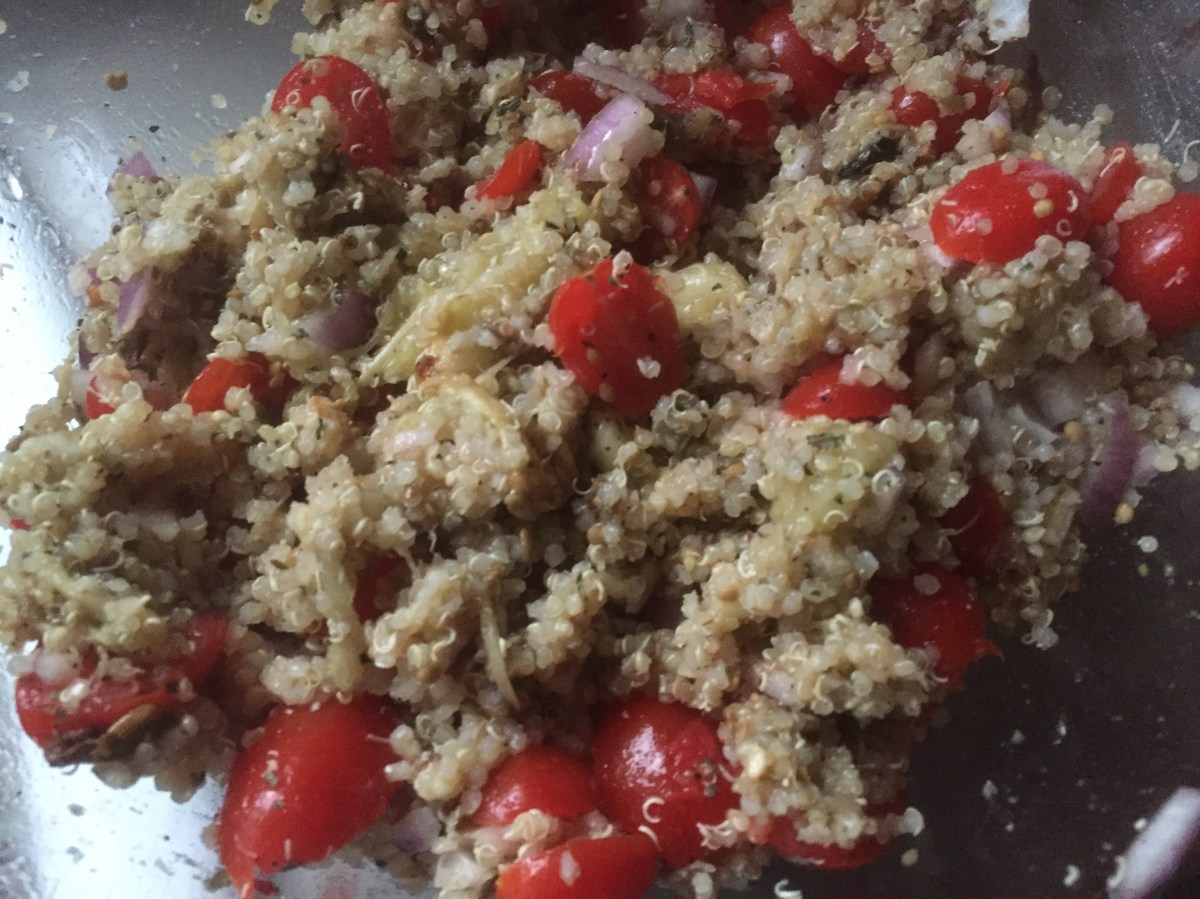
Once the eggplant is out of the oven leave it to cool for 10-15 minutes. This makes it much easier to handle as you will need to scoop out the roasted eggplant flash and mix it with the rest of the stuffing. One time saving tip is to cook your quinoa while the eggplant is roasting and cooling. That way both of your key stuffing ingredients will be ready to go. The rest is easy. You need to wash and half some cherry tomatoes, and dice one red onion. Mix everything together with a bit of dried or fresh basil or oregano, freshly ground black pepper, and even some lemon or lime zest to the stuffing. Any, or all, of these work well together!

stuffed-eggplant-step-1
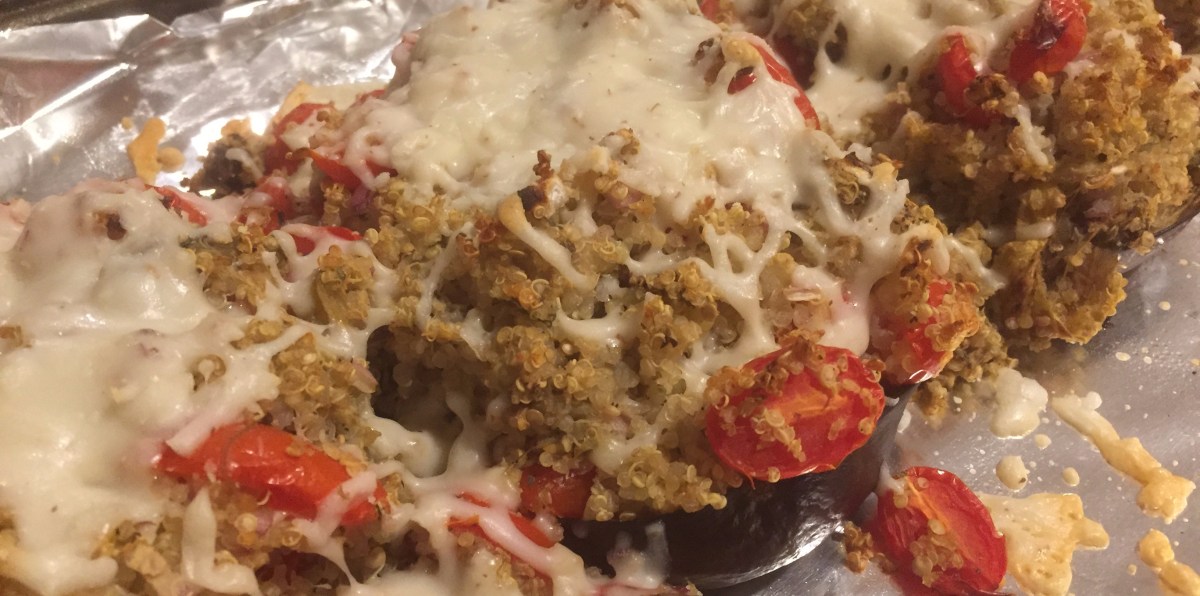
Stuffed Eggplant with Quinoa and Cherry Tomatoes stuffing, via Eat the Vegan Rainbow
Once the stuffing is back in the eggplant shells, and the cheese is sprinkled lightly over the top, the dish goes back to the 350 F (175 C) oven for another 15 minutes or so.

Bon appétite!

Quinoa and Cherry Tomatoes Stuffed Eggplant

What you’ll need:

2 eggplants, large

1 red onion, diced

1 cup quinoa

2 cups water (or vegetable stock)

1 pint (300 g) cherry tomatoes

1/2 cup vegan cheese, shredded

1 teaspoon dry basil

Black pepper, freshly ground

Cooking spray

What you’ll do:

  1. Pre-heat oven to 425 F (220 C).
  2. Wash the two pieces of eggplant and cut in half lengthwise. Place on the aluminum foil covered baking sheet, crosshatch the surface and spray with a cooking spray. Roast in the oven for 20 minutes or until the top is nicely browned. once the eggplant is out, lower the oven temperature to 350 F (180 C).
  3. While the eggplant is roasting, prepare quinoa according to the instructions on the box. I usually cook quinoa in water, but you can definitely use vegetable (vegan) stock if you’d like to add a bit extra flavor.
  4. Once quinoa is fully cooked, transfer into a large mixing bowl. Mix with diced onion and cherry tomatoes that you’ve cut in half lengthwise. Next, scoop out eggplant flash and add to the quinoa stuffing. Lastly, add basil and freshly ground black pepper and mix well.
  5. Spoon a generous amount of stuffing into each eggplant half, spray the top with some cooking spray, and top with shredded cheese. Put the stuffed eggplant back into the oven until the stuffing is heated through, tomatoes cooked, and the cheese melted. This should not take more than 15-20 minutes.
  6. Serve warm!

Copyright © Eat the Vegan Rainbow, 2017

Vegan Zucchini Moussaka

zucchinimousaka_done
Vegan Zucchini Moussaka, via Eat the Vegan Rainbow
Growing up moussaka was probably one of my least favorite dishes. Somehow, layers of potato and ground meat, cooked in rich Béchamel-type of sauce just did not work for me. The version that used zucchini instead of potatoes worked a little bit better, especially when paired up with plain yogurt, but even then the dish was too bland yet to heavy for me.

I decided to give the moussaka of my youth a vegan make-over and I’m happy to report that veganizing this traditional recipe worked! I used rainbow carrots, yellow onion, celery, vegan ground “beef”, all the zucchini ends that are not quite right shape or size to make good layers, and a generous amount of tomato paste for my stuffing.

zucchini-mousaka-ingredients
Zucchini Moussaka ingredients, via Eat the Vegan Rainbow
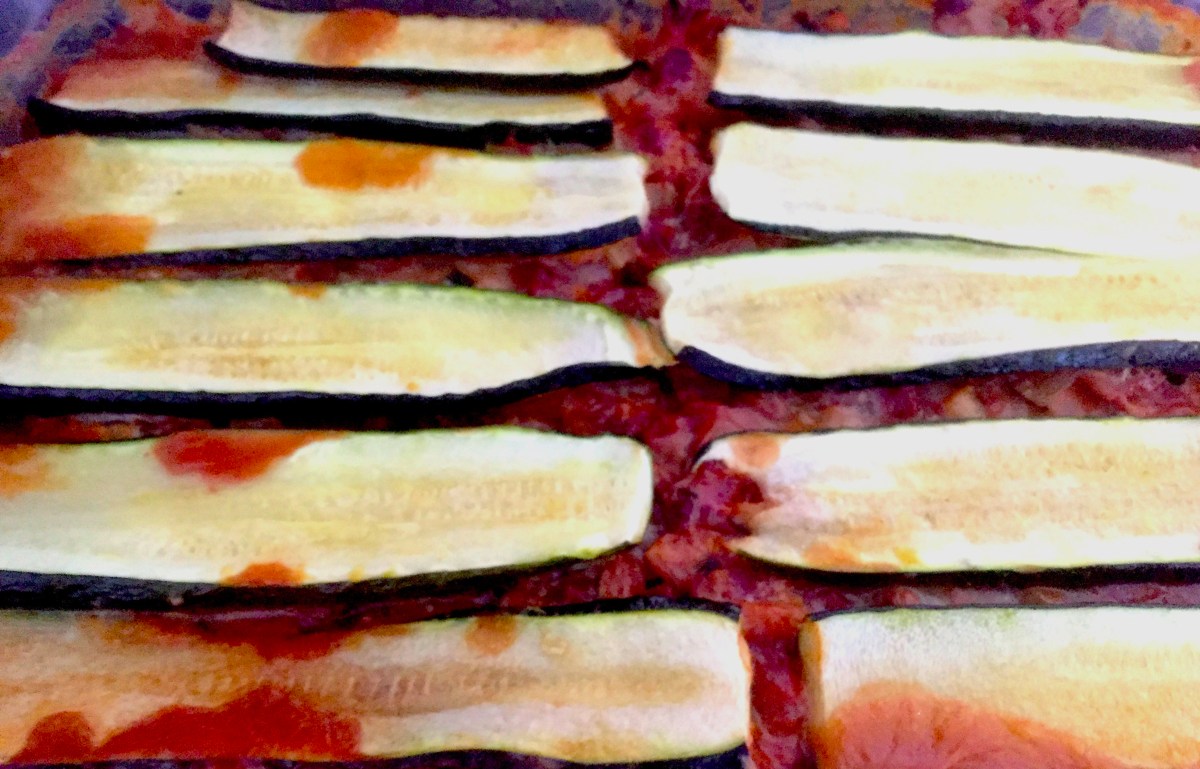
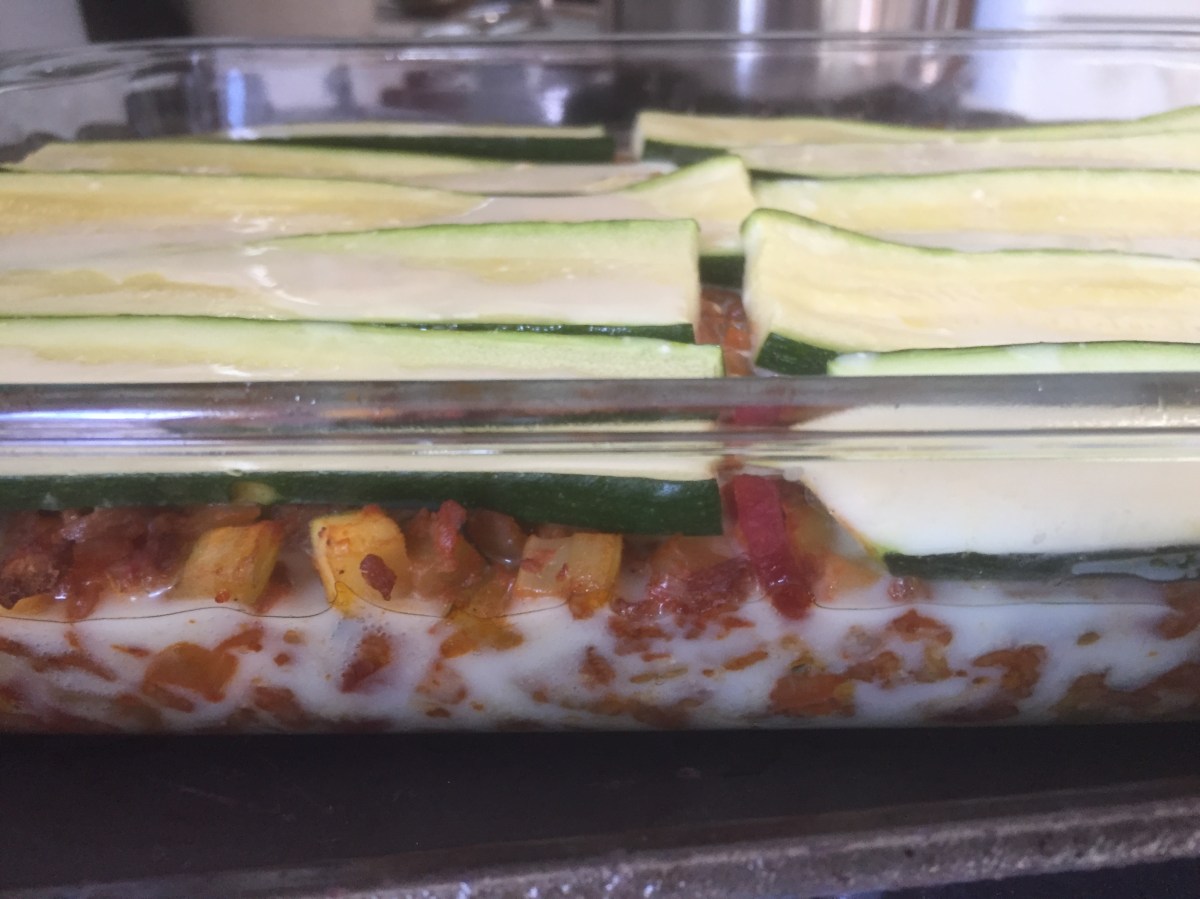
For Béchamel sauce, which usually uses flour, butter and milk, I used almond milk, nutritional yeast and corn starch to make the sauce vegan and gluten free. My moussaka starts with a well oiled deep baking dish, a layer of zucchini slices, stuffing, another layer of zucchini slices and finishes with the vegan Béchamel sauce.

zucchini-mousaka-step-2
Zucchini Moussaka with Vegan Béchamel sauce, via Eat the Vegan Rainbow
The assembled moussaka goes into the oven to cook covered for 30 minutes and uncovered for another 15 minutes. The vegan Béchamel sauce gives this dish great thickness and richness, without making the moussaka heavy. Your taste buds and your tummy will thank you for taking it lightly!

Vegan Zucchini Moussaka

What you’ll need:

4 zucchinis

4 rainbow carrots, diced

6 stalks celery, diced

1 yellow onion, diced

1 cup of vegan ground “beef”, store bought or homemade

2 tablespoons tomato paste

1 teaspoon smoked paprika

2 cups unsweetened, plain almond milk

3 tablespoons corn starch

1 tablespoon nutritional yeast

Cooking spray

What you’ll do:

  1. Preheat the oven to 350 F (175 C).
  2. Spray the bottom and sides of your 13 x 9 in (33 x 23 cm) baking dish with cooking spray. Set aside.
  3. Wash and slice zucchini lengthwise to make 16 to 18 slices that are about 1/4 in (6 mm) thickness. Don’t throw out the left over and edge pieces – dice them to medium size dice and put them in a large mixing bowl.
  4. Add diced onions, carrots and celery to the mixing bowl, as well as vegan ground “beef”, tomato paste, and smoked paprika. Mix well.
  5. Line the bottom of the baking dish with zucchini slices. Pour the filling into the dish. Top with another layer of zucchini slices.
  6. Separately, mix the almond milk, corn starch and nutritional yeast together. Make sure the mix is smooth and lump free. Pour over the moussaka.
  7. Cover the moussaka with foil and bake for 30 minutes. Remove the foil and bake for additional 15 – 20 minutes, until the top is nicely browned.
  8. Take out the oven and let stand for 5-10 minutes before serving.

Copyright © Eat the Vegan Rainbow, 2017
Pizza Supreme, Gluten-free & Vegan

gluten-free pizza with roasted veggies
Gluten-free Vegan Pizza Supreme, via Eat the Vegan Rainbow

Friday night is pizza night, and making this gluten-free version has become part of regular easing into the weekend and unwinding ritual. Quite honestly, developing the perfect gluten-free pizza crust has not been easy. I tried many different recipes, from scratch and store-bought baking mixes, and many different techniques and none really worked. I would end up with a pizza crust that was either too thick or too soggy or too different from a nice thin and crunchy pizza crust that I prefer.

But, all this trial and error has not been a waste, since it led me slowly but steadily to my current recipe that is incredibly simple and works like a charm. Result is a thin and crispy pizza crust that is as close to the real thing as I think I can get. I start from three ingredients: rice flour, baking soda and baking powder. I mix rice flour and water in same amounts (1 cup rice flour to 1 cup water) and the dough I get is nice and smooth, yet slightly sticky. I let the dough sit for 20 to 30 minutes which is just enough time to get my roasted vegetable topping done, and other toppings and sauce organized, and I use a special technique to spread the dough as thin as I like it.

pizzadough_riceflour
Gluten-free Pizza Crust Starts from Rice Flour Dough, via Eat the Vegan Rainbow

What I do to transform this sticky dough into a pizza crust that will bake well and hold the filling is to place a piece of parchment paper on the pizza peel, add enough dough to form one pizza pie, cover the dough with another piece of parchment paper and use fingers to spread the dough out by pressing over the parchment paper. This really help and if you are to try to do this without the second piece of parchment paper you would end up with sticky fingers and mess – trust me on this, I’ve been there! Once the dough is as thin as needed, peel off the top parchment paper, spray the top with cooking spray and the pie is ready for the oven.

There are also two tricks to baking the perfect gluten-free pizza. Trick number one is to give the dough a chance to bake on its own for 10-15 minutes at 425 F (220 C) on a pizza stone. Technically you can use any baking pan or cookie sheet but if you are into making lots of pizza getting a pizza stone is a wise investment – they are pretty much indestructible and one will last you forever! This will help both your top and the bottom get nice and crunchy, browned and caramelized.

The second trick is to pre-cook your toppings. My Gluten-free Vegan Pizza Supreme uses roasted red onions and roasted red peppers, which I slice and roast at 425 F (220 C) for 15-20 minutes while my dough is resting, and couple of other toppings that don’t require pre-cooking like sliced black olives, vegan ground beef substitute, and vegan shredded cheese. Why pre-cook? The assembled pizza will not stay in the oven long enough for toppings like peppers and onions to really brown and soften, and I do prefer them slightly charred. But if you like your veggies on a raw side you can skip this step.

The rest is really a breeze. Cover your half-baked pizza crust with good amount of sauce – on this occasion I used nothing fancier than marinara sauce from a jar – and top with roasted red peppers and red onions, sliced black olives, vegan ground beef substitute, homemade cashew ricotta, store-bought shredded vegan “mozzarella” cheese, or both, sprinkle with dry or fresh basil and oregano, and return to oven for another 12-15 minutes. Take out of the oven and let it rest for 2-3 minutes… or not!

Happy pizza time!!!

glutenfreeveganpizza_whole
Gluten-free Vegan Pizza Supreme on the Menu Tonight, via Eat the Vegan Rainbow

Gluten-free Vegan Pizza Supreme

What you’ll need (for 2 x 12 inch (30 cm) thin-crust pizzas):

2 cups rice flour

2 cups water

1 teaspoon baking powder

1 teaspoon baking soda

1/2 red onion, large

1 red bell pepper

1/2 cup vegan ground beef substitute

1/2 cup sliced black olives

1/2 cup Cashew Ricotta

1/2 cup shredded vegan mozzarella cheese

Cooking spray

What you’ll do:

  1. Preheat oven to 425 F (220 F) with your pizza stone (if using) inside.
  2. In a large mixing bowl, mix rice flour, baking powder, baking soda and add water. Mix everything well until the dough forms. The dough will be soft and relatively sticky, but should still hold its shape. Let stand for 15-20 minutes.
  3. Slice the red pepper and red onion thinly, spread on the cookie sheet covered with aluminum foil, spray with cooking spray and put in the preheated oven for 15-20 minutes, to brown, caramelize and slightly soften.
  4. Place parchment paper on your pizza peel (if not using pizza peel and pizza stone, you would place the parchment paper on your cookie sheet or other baking pan you will be using), put half of your dough in the middle, cover with another piece of the parchment paper and use your fingers to spread the dough out to the size and thickness that you like. Peel the top parchment paper off with care – the dough may stick but the top parchment paper should come off relatively easily. Spray the top of your pizza dough with cooking spray and put in the oven for 12-15 minutes.
  5. Take your pizza crust out of the oven. The top should be slightly golden and the edges should have gotten slightly browned. Spread the tomato sauce and all the toppings you like, and put the assembled pizza pie back in the oven for another 10-15 minutes. Enjoy!

Copyright © Eat the Vegan Rainbow, 2017

Vegan Mexican Lasagna with Soy Chorizo

veganfajitalasagnawithsoychorizo
Vegan Mexican Lasagna with Soy Chorizo, via Eat the Vegan Rainbow

Few years ago when I was first trying to minimize the amount of gluten in my diet, I discovered that corn tortillas work very well as a substitute for lasagna noodles. Corn tortillas as lasagna noodles have quite a few advantages over the regular kind. First of all, they are ready to go and don’t need any preparation. Having said that, I did initially experiment with toasting them just slightly before use, and this did enhance their flavor but at the end the taste benefit was not sufficient to going through the toasting process.

To me the second advantage is the flavor. The regular lasagna noodles are more of a bystanders without adding any specific flavor to the dish, while corn tortillas are in the midst of flavors. As I started using them in lasagnas, I also transitioned away from using Italian ingredients and flavors and to using types of things that you would find in burritos or fajitas.

This Vegan Mexican Lasagna with Soy Chorizo recipe uses the same strategy. I combine two types of peppers and two kinds of onions, which when nicely browned add a hint of fajitas to this lasagna. On this occasion I gave them a pretty fine dice, but you can definitely cut them lengthwise if you are into getting even closer to that fajita style.

mexicanlasagna_ingredients
Vegan Mexican Lasagna with Soy Chorizo Ingredients, via Eat the Vegan Rainbow

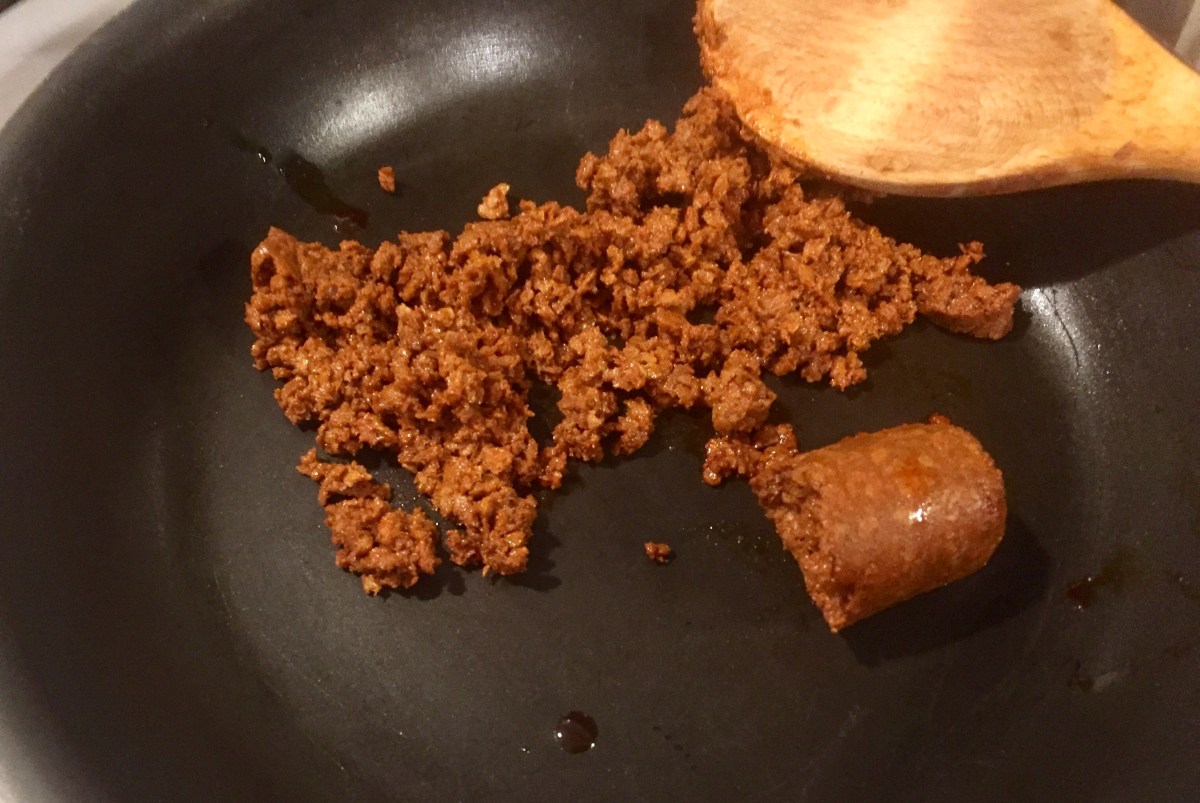
This recipe uses Trader Joe’s Soy Chorizo and because of the intense flavors that this soy chorizo brings to table you will not need to add much, if any, additional spices. Additionally, this soy chorizo is fairly oily so I start with the soy chorizo, let it brown just slightly and release the oil, and then I add peppers and onions and let them cook until veggies are gently caramelized.

mexicanlasagna_soychorizo
Trader Joe’s Soy Chorizo, via Eat the Vegan Rainbow

Once the stuffing mix is done, it is time to assemble the lasagna and, about 25-30 minutes later, enjoy this dish rich in flavor!

Vegan Mexican Lasagna with Soy Chorizo

(2-4 servings)

What you’ll need:

1/2 Trader Joe’s Soy Chorizo

1 red pepper, diced

1 orange pepper, diced

1/2 red onion, diced

1/2 yellow onion, diced

Cooking spray

8 corn tortillas

1/4 cup shredded cheese, vegan

8 x 8 in (20 x 20 cm) baking dish

What you’ll do:

  1. Preheat oven to 375F (190C).
  2. Put Soy Chorizo into a non-stick pan and turn the heat on to medium high. Please note that Trader Joe’s Soy Chorizo comes in a inedible casing that you will have to remove and discard. Use your mixing spoon to break it apart. Let it brown and release its oil for 3-5 minutes.
  3. Add diced peppers and onions to the pan, and let them gently brown and caramelize for 5-10 minutes. The exact time depends on whether you prefer your peppers and onions a bit more on the crunchy side or a bit more on a soft side.
  4. Spray the bottom and the sides of your 8 x 8 in (20 x 20 cm) baking dish with the cooking spray. Place 4 tortillas on the bottom. Add your filling and spread over tortillas evenly. Top with 4 tortillas. Spray the top lightly with cooking spray. Sprinkle the cheese, and cover the dish with foil.
  5. Put the Mexican lasagna into the oven and bake for 20 minutes covered, and the last 5 minutes uncovered so your cheese topping gets nice and melted.
  6. Enjoy!

Note: Just before serving Vegan Mexican Lasagna with Soy Chorizo you can sprinkle the top with fresh cilantro and a squeeze of lime. And while we are packing on some good Mexican flavors, why not add some fresh simple salsa, guacamole, or pickled jalapeños on the side?

Copyright © Eat the Vegan Rainbow, 2017
Jackfruit Tacos

jackfruit-tacco
Jackfruit tacos, via Eat the Vegan Rainbow

I never had jackfruit in my life until last night. And just like that this weird plant food became one of my favorite ingredients and the one I want to use in as many of my dishes as possible. What is jackfruit?

Jackfruit is a popular ingredient in South and Southeast Asian cooking, but it remains obscure to most living in the Western world. This means that finding jackfruit may turn out to be difficult as your regular grocery store is unlikely to carry it. But, let me tell you: jackfruit is so wonderful that it is worth jumping through few hoops to get it. My starting point were online retailers, like Amazon, and that would have been fine has it not been for the fact that I wanted to start cooking right away and could not wait for the delivery.

So I got down to plan B and found a local Asian market, in my case Formosa Marketplace, and the place did not disappoint. They got exactly what I was looking for – young jackfruit in brine. Jackfruit also comes ripe in syrup, but that is not the kind that you want for your savory dishes, plus it is not the kind that seems particularly healthy given all that added sugar.  If you are interested in learning more about jackfruit and getting the idea what type of dishes you can use it in, the Vegetarian Resource Group has a useful post.

How do you get from a can of young jackfruit to a taco filling? It’s super easy. All you need to do is rinse the jackfruit and let it drain and dry. Once the jackfruit stops dripping, you will need to go and pull the fruit pieces apart, which does take a bit of effort and time but makes for more surface area to absorb all the lovely flavors you will add next.

Although you could use a pre-made taco seasoning mix, there’s no need for that as those usually contain quite a lot of quite unnecessary salt. One additional ingredient that you will need is almond cheese. I have not yet figured out how to make almond cheese on my own, so for now I get the one from my local Trader Joe’s. They carry shredded almond cheese that is delicious and affordable.

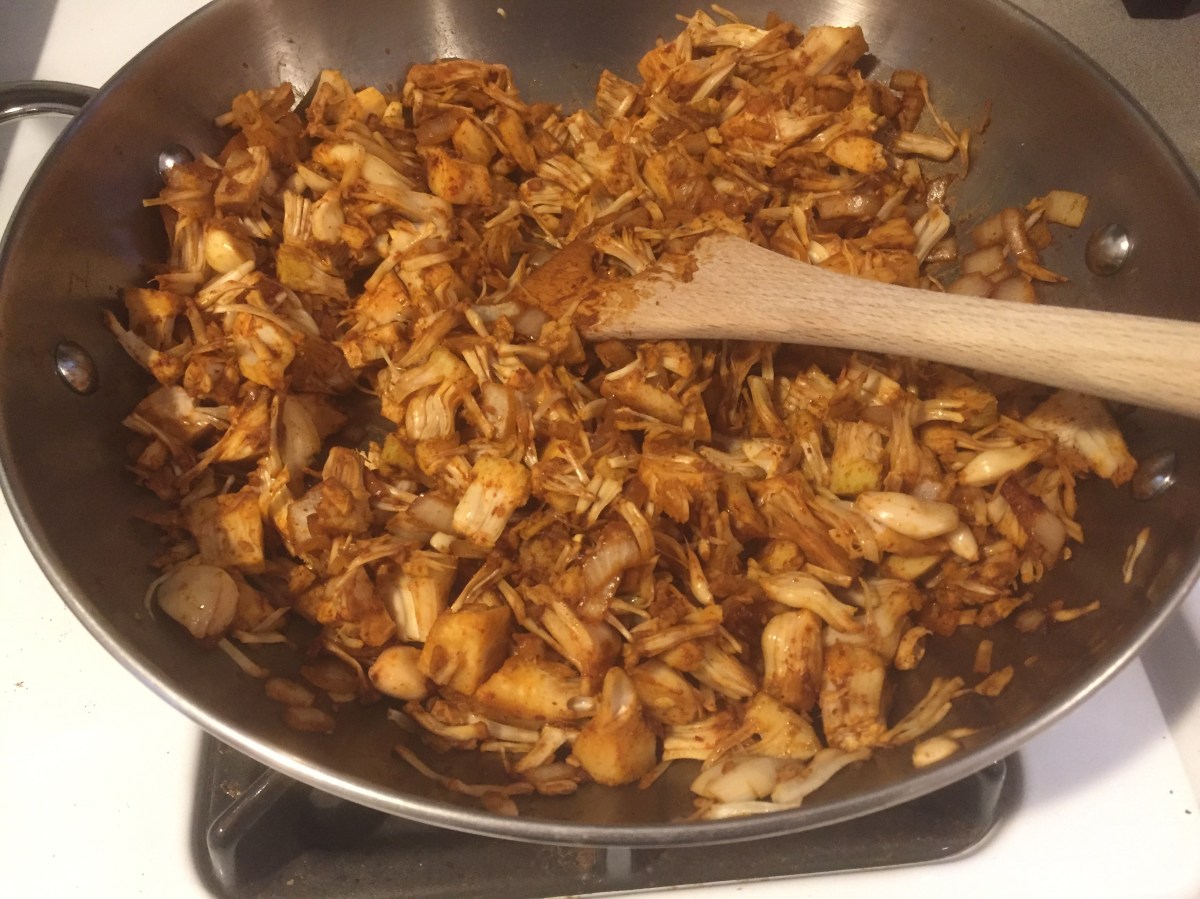
When all is said and done, your jackfruit taco filling will look something like this.

jack-fruit-tacco-filling
Jackfruit Taco filling, via Eat the Vegan Rainbow

To build tacos, you will also need corn tortillas, but possibilities are close to endless. You can customize your tacos by adding salsa, avocado, fire roasted green chili peppers, cilantro, lime juice, and shredded iceberg lettuce. For me some cucumber slices and pearl tomatoes on the side hit the spot!

Jackfruit Tacos

What you’ll need (for 4 tacos, 2 people):

1 10 oz. (280 g) can of young jackfruit in brine

1 onion, finely diced

1 tablespoon minced garlic

1 teaspoon smoked paprika

1 teaspoon chili powder

1/2 lime, just juice

1/4 cup water

4 corn tortillas, soft

1/2 cup almond cheese

cooking spray

What you’ll do:

  1. Place jackfruit in a strainer and rinse it well with water to get rid of the salty brine. Let the jackfruit drain for 15-20 min, and then pat dry with a paper, or a cloth towel. Next, pull the jackfruit pieces apart to get a pile of finer shreds.
  2. Spray the bottom of a pan with cooking spray and turn the heat to medium high. Add finely diced onion and minced garlic to the pan and let the onion and garlic aromas develop for 3-5 min.
  3. Next add the spices and let them simmer for 1-2 min. This will help the spices toast and intensify the flavor. Don’t worry if some of your spices, onion or garlic stick to the bottom of the pan as lime juice and water that you’ll add next will serve to deglaze the bottom. You may need to adjust the amount of water as you go along, so I recommend starting easy by adding 1-2 tablespoons and going from there.
  4. Once you are happy with the deglazing and the consistency, which should be somewhere between the ketchup and tomato paste, it’s time to add jackfruit. Make sure jackfruit is fully coated with your sauce, and simmer for 5-10 min, until jackfruit browns just slightly. Leave to the side.
  5. Heat a non-stick frying pan with cooking spray and place over high heat. Put one corn tortilla in, top it with jackfruit filing and 1/4 of your cheese and fold the tortilla over. Brown on one side for 1-2 min then flip over and brown on the other side for 1 min or so.
  6. Enjoy!

Note: You can use leftover taco filling in number of different ways. You can top a sandwich, or rice and other grains, as well as pasta or zucchini spaghetti

Copyright © Eat the Vegan Rainbow, 2017